Presenteeism at work is the biggest hidden line item on the P&L that almost nobody tracks: presenteeism costs UK employers £103 billion annually, nearly 28 times more than the £3.7 billion attributed to absenteeism in the same period, according to research by the Institute for Public Policy Research. In the US, Harvard Business Review estimates the figure at US$150 billion per year, roughly 10 times the cost of absenteeism. Yet most HR dashboards track absence days obsessively and measure presenteeism not at all. For CHROs and People leaders, this is not a reporting gap. It is a strategic blind spot with a nine-figure price tag.
Presenteeism at work is the single largest hidden cost in most large organisations, and the one least likely to appear in any board report. Unlike absenteeism, which generates a visible paper trail of sick days and replacement costs, presenteeism is silent: the employee is physically present, their salary is being paid, and the damage accumulates invisibly in reduced output, compounding errors, declining team performance, and eventual burnout. The organisations closing this gap are the ones that treat presenteeism as a measurable financial risk, not a cultural observation, and that invest in the clinical and data infrastructure to detect it before it becomes a leave or a resignation.

Why presenteeism outweighs absenteeism and why most organisations miss it
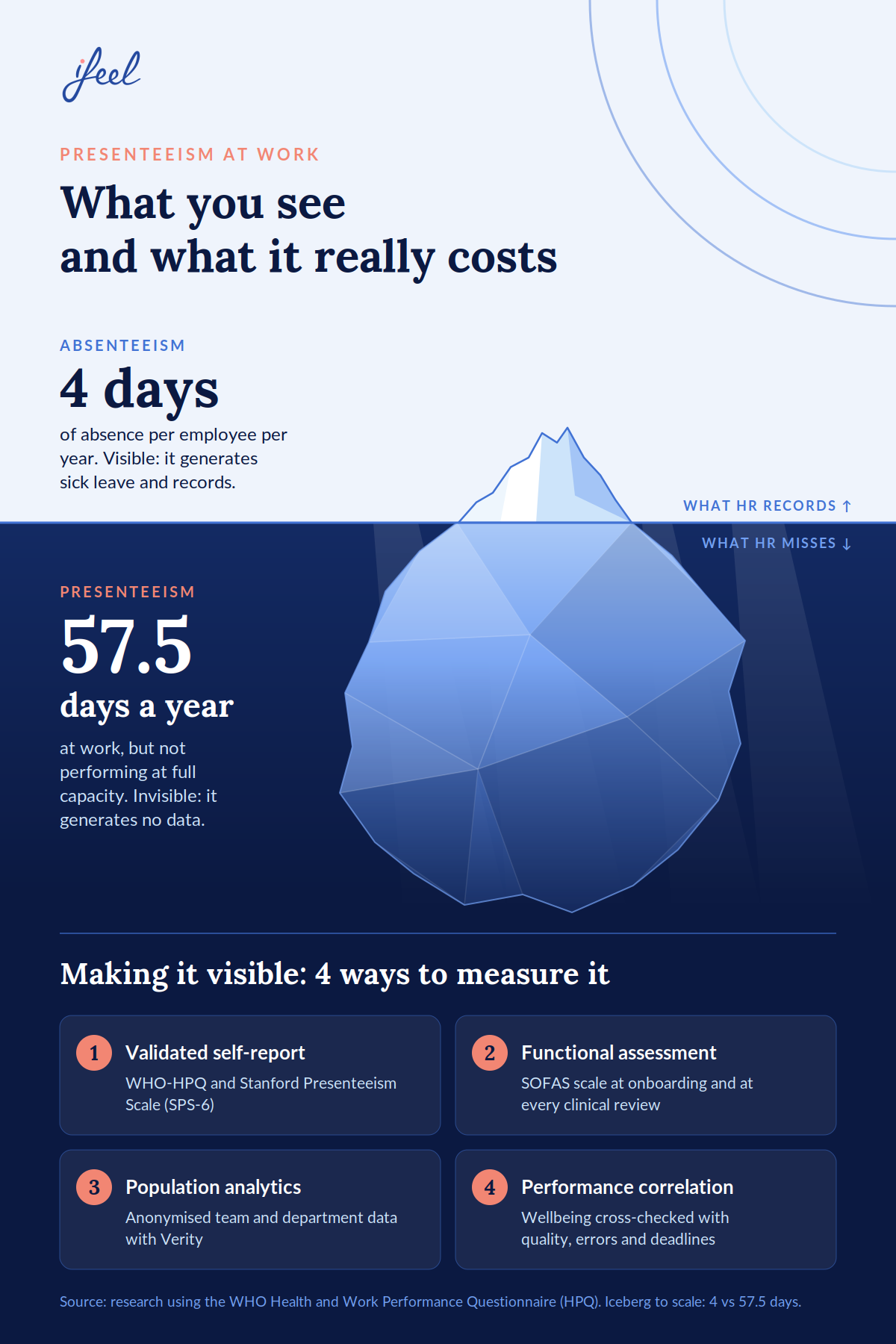
The scale of the imbalance between presenteeism and absenteeism costs is striking by any measure. Research using the WHO Health and Work Performance Questionnaire Questionnaire found that while employees are absent from work an average of four days per year, they report being unproductive on the job for 57.5 days annually: the equivalent of almost three working months of lost output per person per year, at 75% of maximum productivity.
The financial arithmetic is equally striking. Presenteeism costs US businesses up to US$150 billion per year, nearly 10 times the cost of absenteeism. In Japan, mental health-related presenteeism losses were estimated at US$46.73 billion compared to US$1.85 billion for absenteeism, a ratio of more than 25 to one. A Canadian study found that high psychological distress was associated with presenteeism costs of between $6,944 and $8,432 per person annually, compared to absenteeism costs of $2,337 to $2,796. Across every major economy where this comparison has been made, presenteeism consistently dwarfs absenteeism by a factor of several multiples.
The reason it goes unmeasured is structural. Absenteeism generates a data point the moment an employee calls in sick. Presenteeism generates no data point at all, only a slow, invisible degradation of output that rarely triggers an HR alert until it has already caused significant damage. Without a deliberate measurement framework, CHROs are managing the smaller, more visible cost while the larger one accumulates unchecked. The full financial picture of absenteeism and presenteeism combined is where the true scale of the risk becomes clear.
What is driving presenteeism in 2025 and 2026
Mental health is by far the largest driver. Employees experiencing anxiety, depression, or burnout are significantly more likely to be physically present but functionally impaired. They come to work because they feel they cannot take time off, or because the culture does not support doing so, while operating at a fraction of their clinical capacity. Understanding how to prevent burnout at the organisational level is inseparable from understanding how to prevent presenteeism, because they share the same root causes and the same early warning signals.
The structure of modern work amplifies this. Hybrid and remote environments, while broadly positive for engagement and retention, introduce a specific presenteeism risk: digital presenteeism, where employees feel compelled to be visibly online and responsive regardless of their functional state. A 2023 survey estimated that 90% of US workers worked while sick at some point that year, with 40% hesitant to take available sick leave. The always-on expectation of remote and hybrid work does not eliminate presenteeism; it relocates it.
Organisational culture is the third driver. Where managers implicitly or explicitly reward visible effort over outcomes, where taking leave is culturally coded as a performance weakness, and where wellbeing programmes exist on paper but are not modelled by leadership, presenteeism becomes the rational survival strategy for employees who cannot afford to be seen as disengaged. The result is a workforce that shows up, stays quiet about how they are actually functioning, and slowly burns out.
The clinical dimension: presenteeism as a mental health risk indicator
Presenteeism is not simply a productivity problem. It is a clinical warning signal. An employee operating at significantly reduced functional capacity over an extended period is an employee whose mental health is deteriorating and who, without intervention, is statistically more likely to progress to a formal mental health sick leave.
ifeel’s clinical model uses the SOFAS scale (Social and Occupational Functioning Assessment Scale) to measure functional impairment at the individual level. This provides a validated, clinical assessment of an employee’s actual occupational functioning: not their self-reported busyness, not their attendance record, but their genuine capacity to perform. Employees scoring below threshold are identified as medium or high risk and receive prioritised clinical support before their functional impairment compounds further.
This is the clinical logic behind early intervention: a medium-risk employee supported at the presenteeism stage costs a fraction of what the same employee costs at the absenteeism stage. ifeel’s analysis shows that a mid to high-risk employee left unsupported can cost between 15,000 and 50,000 EUR annually, a figure that includes the presenteeism losses that never appear in a standard absence management report. A thorough psychosocial risk assessment is the foundational step that makes this level of clinical precision possible.
How to measure presenteeism: from invisible to quantifiable
The most common reason CHROs do not measure presenteeism is the assumption that it cannot be measured with the rigour that absenteeism can. This is no longer true. There are several validated measurement approaches available to large organisations.
Validated self-report tools. The WHO Health and Work Performance Questionnaire (HPQ) and the Stanford Presenteeism Scale (SPS-6) both provide reliable, validated measures of presenteeism at the individual and population level. These can be embedded in existing employee surveys or administered as standalone assessments on a quarterly basis.
Functional assessment at onboarding and review. ifeel’s clinical triage model includes a functional scoring component that identifies impairment at the point of employee onboarding and at regular clinical review intervals. This creates a longitudinal data set that tracks individual functional trajectories over time, enabling HR teams to identify deteriorating trends before they cross into clinical risk territory.
Population-level analytics via Verity. ifeel’s Verity platform aggregates anonymised wellbeing and functional data at the team, department, and demographic level, giving CHROs a real-time view of where presenteeism risk is concentrated, how it tracks over time, and which interventions are producing measurable functional improvement. This is the data layer that makes presenteeism visible on a board report for the first time.
Output and performance correlation. Where HR data systems allow, correlating wellbeing assessment scores with objective performance metrics (output quality, error rates, deadline adherence, manager ratings) creates a cross-validated presenteeism signal that is both clinically grounded and operationally meaningful.

Making the board case: presenteeism as a financial risk metric
The barrier to board-level action on presenteeism is rarely scepticism about its existence. It is the absence of a number. Boards respond to quantified financial risk. The organisations that have successfully secured C-suite investment in presenteeism management are the ones that arrived at the board table with a figure, not an observation.
The calculation framework is straightforward. Take your average employee salary. Apply the productivity impairment percentage identified through validated measurement (typically 20 to 40% for employees experiencing moderate mental health challenges). Multiply by the number of working days per year and the estimated proportion of your workforce experiencing presenteeism at any given time. The resulting figure, the annual presenteeism cost to your organisation, is almost always larger than any board member expects, and almost always larger than the proposed investment in prevention.
For a large enterprise of 5,000 employees, with an average salary of 45,000 EUR and a conservative presenteeism prevalence of 25% at 30% productivity impairment, the annual cost exceeds 16 million EUR. The investment required to address it is a fraction of that figure. ifeel’s corporate partners consistently achieve a 3x ROI within 12 months. The financial case, when properly constructed, is one of the most compelling available to any CHRO seeking board support for a wellbeing investment. Building a mentally healthy organisation starts with making the invisible cost of presenteeism visible and then acting on it with clinical precision.
Presenteeism at work: from invisible cost to strategic priority
| Dimension | Absenteeism | Presenteeism |
|---|---|---|
| Visibility | Immediately visible: triggers HR record | Invisible: no automatic data point generated |
| Annual cost (UK) | £3.7 billion (IPPR, 2025) | £103 billion (IPPR, 2025) |
| Measurement tools | Absence management systems | WHO-HPQ, SPS-6, SOFAS, Verity population data |
| Clinical signal | Leave already issued, so intervention comes late | Functional impairment detectable before leave |
| Strategic response | Absence management policy | Prevention-first, clinically informed wellbeing programme |
Frequently asked questions: presenteeism at work
What is the difference between absenteeism and presenteeism?
Absenteeism occurs when an employee is absent from work, generating a visible record in HR systems. Presenteeism occurs when an employee is physically present (or digitally visible in hybrid environments) but is not functioning at full capacity due to physical or mental health challenges. Presenteeism is harder to detect, harder to measure, and consistently more expensive than absenteeism across every major economy where the comparison has been made.
Why does presenteeism cost more than absenteeism?
Because it is both more prevalent and more sustained. An employee on sick leave is absent for a defined period, after which they return or are replaced. An employee experiencing presenteeism may operate at significantly reduced capacity for months or years, continuously draining productivity, quality, and team performance without triggering any formal HR response. The cumulative loss across a large workforce, sustained over time, far exceeds the discrete cost of individual absences.
How can HR leaders measure presenteeism in their organisation?
The most effective approach combines validated self-report tools such as the WHO Health and Work Performance Questionnaire or the Stanford Presenteeism Scale with population-level functional data from a clinical wellbeing platform. ifeel’s Verity platform provides real-time, anonymised data on functional wellbeing risk across teams and departments, giving HR leaders the quantified evidence base needed to make the board case for investment and to track the ROI of interventions over time.
What is the link between presenteeism and mental health?
Mental health is the primary driver of presenteeism in most large organisations. Employees experiencing anxiety, depression, burnout, or chronic stress are significantly more likely to attend work while functionally impaired, either because the culture does not support taking mental health leave, or because they are not aware that what they are experiencing is clinically significant. Presenteeism is therefore best understood as an early-stage mental health risk signal and the most cost-effective intervention point in the mental health risk cycle.
How does ifeel address presenteeism specifically?
ifeel’s clinical model identifies presenteeism risk through functional assessment at the point of employee onboarding, using the SOFAS scale to measure occupational functioning rather than simply absence rates. Medium and high-risk employees receive early clinical intervention before their functional impairment progresses to a formal leave. ifeel’s Verity platform then provides population-level visibility into where presenteeism is concentrated, enabling CHROs to target resources with precision and track the financial return on intervention. The result is a 30%+ reduction in mental health-related absenteeism risk and a 3x ROI within 12 months.
Why ifeel is the partner you need
Presenteeism will not appear on your absence report. It will not generate a sick-day record, a GP note, or a formal HR case. It will simply cost your organisation millions each year in productivity it never sees, innovation it never captures, and talent it eventually loses to burnout or attrition, all while your HR systems report a healthy absence rate and your board assumes the workforce is performing.
ifeel makes the invisible visible. Through clinical functional assessment, validated wellbeing measurement, and the real-time population analytics of the Verity platform, ifeel gives CHROs the data, the clinical infrastructure, and the financial evidence to turn presenteeism from a boardroom blind spot into a managed, measurable risk. With a guaranteed adoption rate of 20%+, a 3x ROI within 12 months, and a 30%+ reduction in mental health-related absenteeism risk, ifeel closes the gap between what your organisation knows about its workforce and what it needs to know.
The cost of presenteeism is already being paid. The question is whether your organisation is measuring it, managing it, or simply absorbing it.
Get in touch with our team to find out how ifeel helps CHROs measure and reduce the hidden cost of presenteeism across their organisation.
Leadership lens 🔍
The board measures what it can see. Absenteeism is visible: it generates records, costs, and reports. Presenteeism is not: it generates nothing except a quiet, compounding drain on the productivity, quality, and resilience of your organisation.
C-suite leaders who have not yet asked their CHRO to quantify presenteeism are unknowingly approving its cost every quarter. The organisations building genuine competitive advantage are the ones treating functional workforce performance as a measurable financial metric and investing in the clinical and data infrastructure to manage it with the same rigour they apply to every other material risk on the balance sheet.