Mental health absence at work has become one of the sharpest cost pressures facing HR teams: 17.1 million working days were lost to mental health-related sickness absence in the UK alone in 2025 — making it one of the single largest drivers of workplace absence on record. Across Europe, the picture is equally stark: around 50% of all long-term sick leave is linked to stress, depression or anxiety, and the financial burden on employers runs into tens of billions annually. For CHROs and HR Directors, mental health absence is no longer a welfare issue to be managed quietly. It is a business continuity risk that demands a strategic response.
Mental health absence at work is one of the most significant and fastest-growing cost centres in large organisations. Effective management requires a three-stage approach: early identification of at-risk employees before a leave occurs, structured support during the absence itself, and a clinically informed return-to-work protocol that reduces the risk of relapse. Organisations that get this right reduce costs, protect productivity, and demonstrate the duty of care that today’s workforce expects. Those that rely on reactive, ad hoc responses will continue to absorb preventable costs — and preventable losses of talent.

Why mental health absence is now a boardroom issue
The scale of the problem has reached a point where it can no longer sit exclusively with HR. Nearly half (47%) of HR Directors now report that mental health conditions are among the leading causes of long-term sick leave in their organisation. Mental ill health costs UK employers an estimated £42 billion to £45 billion annually through presenteeism, sickness absence, and staff turnover. For every £1 invested in mental health interventions in the workplace, organisations see an average return of £5.
The duration and severity of mental health leave compounds the financial impact. Mental disorders are associated with longer periods of work absence compared to other health conditions, and the likelihood of returning to work decreases progressively with the length of time away. Recurrence is also a significant risk: relapse may affect 20 to 30% of workers who return to work within a ten-year period, with subsequent episodes typically more severe and resulting in longer absences than the initial one.
At an individual level, ifeel’s analysis shows that a mid to high-risk employee left without structured support can cost between 15,000 and 50,000 EUR annually — covering direct absence costs, presenteeism losses, replacement, and recruitment. When mental health-related absenteeism risk is not actively managed, these costs accumulate silently across the organisation, quarter by quarter. The full financial picture of absenteeism and presenteeism makes the case for proactive investment unambiguous.
Why the current approach is not working
Most large organisations have an absence management policy. Far fewer have a mental health-specific absence protocol — one that distinguishes between a physical health leave and a mental health leave, and that provides structured, clinically informed guidance at each stage. The gap between policy and practice is where costs accumulate.
Traditional Employee Assistance Programmes, where they exist, typically offer reactive support: a helpline to call once a crisis has already occurred. Utilisation rates sit below 5% across most traditional EAP providers, meaning the majority of employees who need support are not accessing it. By the time a mental health sick leave is issued, the window for early intervention has already closed.
The absence of early detection tools is a critical failure point. Without population-level data on employee wellbeing risk, HR teams are managing absence reactively — responding to a leave rather than preventing one. ifeel’s Verity platform changes this dynamic by providing real-time, anonymised insights into team-level and department-level wellbeing risk, enabling HR leaders to intervene before risk escalates into absence.
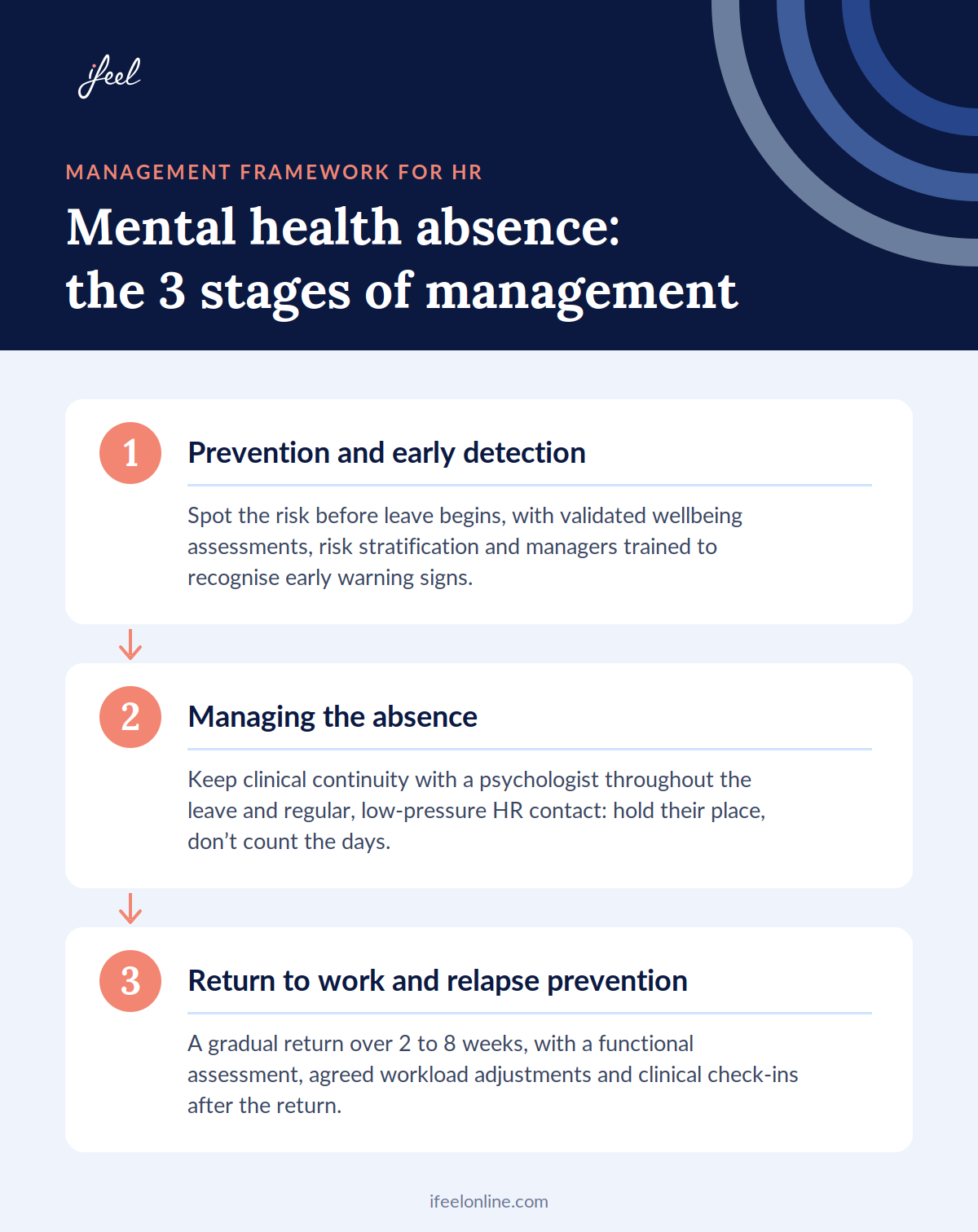
Stage one: early identification and prevention
The most effective management of mental health absence happens before the leave is issued. Organisations that invest in early detection — through regular, validated wellbeing assessments, manager training, and accessible clinical support — consistently report lower rates of mental health-related absence and shorter duration when leaves do occur. A well-designed corporate mental wellness programme creates the structural conditions for this kind of early, proportionate intervention.
ifeel’s clinical model uses a risk stratification framework at the point of employee onboarding. A sociodemographic questionnaire, a guided clinical assessment, and a functional scoring tool based on the SOFAS scale (Social and Occupational Functioning Assessment Scale) identify employee risk levels — low, medium, or high — and enable HR teams to allocate support proportionally. Medium and high-risk employees receive prioritised clinical intervention before their risk translates into a leave.
Manager capability is equally critical. Fewer than 11% of workplaces require mental health training for managers, yet managers are typically the first point of contact when an employee’s performance or behaviour changes. Training managers to recognise early warning signals — declining output, increased absence patterns, visible disengagement, changes in communication style — and to have confident, compassionate conversations creates the earliest possible intervention point in the absence cycle.
Stage two: managing the absence with structure and clinical continuity
When a mental health leave does occur, the quality of support provided during the absence directly determines the likelihood of a successful return. Employees left without structured support during a leave are at significantly higher risk of extended absence and relapse on return.
Clinical continuity is the cornerstone of effective absence management. An employee on mental health leave should have consistent access to a qualified psychologist throughout the absence period — not just a helpline referral at the point of crisis. ifeel’s 1,000+ licensed psychologists across 90+ countries and 50+ languages provide the clinical depth needed to support employees through extended absences, regardless of location or language.
HR communication during the absence period requires careful management. Maintaining regular, low-pressure contact with the employee — to keep them connected to the organisation without creating performance pressure — reduces stigma, builds trust, and supports a smoother return. The message should be clear: the organisation is holding space for their return, not counting the days. Clear documentation of agreed communication protocols, conducted through HR rather than line managers where appropriate, protects both the employee and the organisation.
Stage three: structured return to work and relapse prevention
The return-to-work phase carries the highest risk of relapse if not managed with clinical precision. A meaningful share of employees who return from mental health leave without a structured protocol end up back on leave for the same reason within two years. Getting returning to work after sick leave right is not optional — it is the difference between a resolved absence and a recurring one.
A phased return is the clinical standard. Starting with reduced hours and limited responsibilities, and incrementally rebuilding workload over a structured period of two to eight weeks, allows the employee to re-establish their functional capacity without triggering a relapse. Flexibility around schedule and task allocation during the early return period is not a concession — it is the evidence-based approach that produces the best outcome for both the employee and the organisation.
The return-to-work conversation should be conducted by a trained manager or HR professional who has reviewed the employee’s functional assessment and has a clear plan. It should address: adjusted responsibilities during the transition period, communication preferences around the absence, any workplace modifications required, and the support resources available going forward. What it should not do is place the employee in a position where they feel they must justify or explain their absence in detail to colleagues or line managers.
Relapse prevention requires ongoing support after the return. Regular clinical check-ins in the weeks following return, continued access to psychological support, and a named point of contact within HR create the safety net that turns a successful return into a sustained one.
Mental health leave management: a framework for CHROs
| Stage | Key actions | ifeel’s role |
|---|---|---|
| Prevention and early detection | Risk stratification, manager training, validated wellbeing assessments | Clinical triage model, Verity real-time risk data, manager training resources |
| Absence management | Clinical continuity, structured HR communication, documentation protocols | 1,000+ licensed psychologists, ongoing therapy during absence, HR advisory support |
| Return to work and relapse prevention | Phased return plan, functional assessment, ongoing clinical check-ins | Return-to-work clinical framework, continued psychological support, population-level outcome tracking |
Frequently asked questions: mental health absence at work
What is the difference between managing physical and mental health absence?
Mental health absence requires a fundamentally different management approach to physical health leave. Unlike a physical condition with a clear clinical prognosis and a defined recovery timeline, mental health conditions are influenced by workplace factors, personal circumstances, and the quality of support received during the leave itself. A one-size-fits-all absence policy will consistently underperform when applied to mental health leave. Organisations need a dedicated, clinically informed protocol for each stage: prevention, absence management, and return to work.
How can HR prevent mental health leave from occurring in the first place?
Prevention starts with visibility. Without data on employee wellbeing risk, HR teams are managing absence reactively. Regular, validated wellbeing assessments — combined with manager training in early recognition and accessible clinical support from day one — create the conditions for early intervention. ifeel’s clinical triage model identifies medium and high-risk employees before their risk escalates, enabling proportionate, timely support that prevents a significant proportion of mental health-related leaves from occurring at all.
What does a structured return-to-work plan look like in practice?
A structured return-to-work plan typically includes a phased schedule that incrementally rebuilds hours and responsibilities over two to eight weeks, a functional assessment conducted by a clinical professional, agreed adjustments to workload and work environment where needed, a named HR point of contact for the transition period, and a schedule of clinical check-ins to monitor the employee’s recovery trajectory. The plan should be documented, agreed by the employee, and reviewed regularly during the transition period.
How does ifeel support organisations during mental health-related absence?
ifeel provides clinical and strategic support across all three stages of the absence cycle. During prevention, ifeel’s triage model identifies at-risk employees and provides proportionate, early clinical intervention. During absence, ifeel’s network of 1,000+ licensed psychologists across 90+ countries maintains clinical continuity for the employee. During the return-to-work phase, ifeel’s clinicians support the functional assessment and phased reintegration. Throughout, ifeel’s Verity platform gives HR leaders real-time, anonymised population-level data to track risk, measure outcomes, and build the evidence base for continued investment.
What is the financial return on investing in mental health absence management?
The return is significant and measurable. For every £1 invested in mental health interventions in the workplace, employers see an average return of £5 through reduced absence, lower presenteeism, and improved retention. ifeel’s corporate partners consistently report a 30%+ reduction in mental health-related absenteeism risk and a 3x ROI within 12 months. The cost of a mid to high-risk employee left unsupported — between 15,000 and 50,000 EUR annually — makes the investment case straightforward when set against the cost of a structured prevention and support model.
Why ifeel is the partner you need
Mental health absence management is not a process problem. It is a clinical problem with significant financial consequences. Organisations that treat it as an administrative function — managing paperwork and leave policies — will continue to absorb costs that a clinical, prevention-first approach would eliminate.
ifeel provides the clinical infrastructure, digital accessibility, and data intelligence that transform mental health absence from a reactive cost into a managed, measurable risk. With a network of 1,000+ licensed psychologists across 90+ countries and 50+ languages, a guaranteed adoption rate of 20%+, and a 30%+ reduction in mental health-related absenteeism risk, ifeel gives CHROs the tools to act at every stage of the absence cycle. The Verity platform provides the population-level insight to identify risk before it becomes absence — and the evidence base to demonstrate the value of that investment to the board.
The organisations that will build the most resilient workforces in the years ahead are the ones treating mental health absence as a strategic priority today.
Get in touch with our team to find out how ifeel helps CHROs build a strategic, clinically grounded approach to mental health absence management.
Leadership Lens
Leadership lens 🔍
Mental health-related absence is not a people risk. It is a business continuity risk. When a mid to high-risk employee goes on extended leave without a structured return-to-work protocol, the organisation absorbs costs that extend far beyond the absence itself: team productivity losses, manager bandwidth consumed by cover arrangements, recruitment and onboarding if the employee does not return, and the reputational signal sent to the wider workforce about how the organisation responds to mental health. C-suite leaders who treat this as an operational matter for HR to manage are underestimating the strategic exposure. The organisations building genuine resilience are the ones integrating clinical-grade mental health absence management into their risk frameworks — not their wellbeing programmes.