Gen Z mental health at work is fast becoming the defining workforce risk of this decade: Generation Z will make up approximately 30% of the global workforce by 2030 — and right now, they are burning out faster than any generation before them. According to a UKG global study of nearly 13,000 frontline workers, 83% of Gen Z employees report the highest levels of work-related stress, and a Seramount survey from July 2025 found that 72% of Gen Z workers experience at least one symptom of burnout. For CHROs and People leaders, this is not a generational curiosity. It is a talent pipeline risk, a retention liability, and a direct challenge to long-term business resilience.
Gen Z mental health at work is the defining talent challenge of the next decade. This generation demands mental health support as a baseline employment condition, not a benefit add-on. Organisations that meet this expectation reduce voluntary turnover, improve engagement, and build the workforce pipeline their business depends on. Those that don’t will face rising recruitment costs, productivity gaps, and an accelerating attrition cycle. The four strategic actions that matter most: embed mental health into the employee value proposition, replace low-utilisation EAPs with digital-first platforms, equip managers to have early conversations, and measure wellbeing outcomes with the same rigour applied to financial KPIs.
Why Gen Z is burning out — and why it matters to your bottom line
The generational divide in burnout has widened dramatically. Gen Z and millennial workers are now hitting peak burnout at just 25 years old, a full 17 years earlier than the average American, who experiences peak burnout at 42. This is not a story about young workers struggling to adapt. It is a structural signal about how modern organisations are designed and who pays the price.
Burnout is widespread across the working population, but the numbers are particularly striking for younger employees. 72% of Gen Z workers report experiencing at least one symptom of burnout, such as exhaustion or feeling unmotivated, compared to 62% of Gen X employees and just 38% of Baby Boomers. The trend is not correcting. If anything, it is accelerating.
The business case is unambiguous. Globally, an estimated 12 billion working days are lost every year to depression and anxiety, at a cost of US$1 trillion per year in lost productivity. When the fastest-growing segment of your workforce is also the most at-risk, the financial exposure compounds year on year. At an individual level, ifeel’s analysis shows that the cost of a mid to high-risk employee left unsupported can reach between 15,000 and 50,000 EUR annually in direct and indirect costs, covering absenteeism, presenteeism, and voluntary turnover combined.
SHRM research finds that 61% of Gen Z workers would strongly consider leaving their current job if they were offered a new role with significantly better mental health benefits. That is not a preference. That is a competitive threat every CHRO with a talent retention mandate needs to take seriously.
Why Gen Z is burning out: the structural drivers
Understanding the root causes is the first step toward designing interventions that work. Gen Z did not enter the workforce under stable conditions. Constant connectivity, financial stress, and entering the labour market during the pandemic pushed this generation to its limits before many had completed their first full year in employment.
The architecture of modern work further intensifies burnout risk. Entry-level roles often demand high performance with limited autonomy, while the boundaries of gig and freelance economies blur the line between employment and constant availability. At the same time, workplace cultures have not fully adapted to the mental health expectations that Gen Z regards as non-negotiable. For a deeper look at how AI anxiety at work is compounding these pressures for younger employees specifically, the evidence is increasingly hard to ignore.
Financial precarity is a compounding factor that sits outside the workplace but lands squarely within it. 65% of Gen Z report not feeling financially stable, and when asked about the single benefit most likely to improve their mental health, 41% identified remote flexibility as their preferred response. This generation is not simply asking for more. They are asking for something different: workplaces that acknowledge the full weight of what they are navigating outside working hours, as well as within them. Understanding the full spectrum of employees’ mental health pressures is essential context for any CHRO designing a meaningful response.
The EAP gap: why traditional support is failing the workforce you most need to retain
Most large organisations have an employee assistance programme in place. Many have implemented these as their primary mental health response. Yet traditional EAPs have proved structurally insufficient, with participation rates below 5% and a generic, reactive approach that fails to meet the specific needs of a diverse, international workforce.
The problem is one of format as much as content. Traditional EAPs were designed for a workforce that picks up the phone, waits for a referral, and attends in-person sessions. 60% of Gen Z prefers virtual care over in-person visits. A generation that grew up with on-demand, app-native services is not going to engage with a helpline number buried in an employee handbook.
The appetite for mental health support is demonstrably there. 42% of Gen Z say they are currently in therapy, a 22% increase since 2022. What is missing is the right delivery channel and the right clinical depth. When support is offered in a format Gen Z actually uses, engagement follows. ifeel delivers engagement rates 10x higher than traditional EAPs, with a guaranteed adoption rate of 20%+, because the platform is designed for how this generation actually seeks help. Knowing how to prevent burnout at the organisational level starts with closing this access gap.
What Gen Z expects from their employer — and how CHROs can respond
72% of Gen Z employees prioritise flexibility, mental health support, and career development when choosing an employer. These are not soft preferences. They are decision criteria that determine whether a candidate accepts an offer and whether an employee stays long enough to become a meaningful contributor.
Generation Z is reshaping workforce expectations with their values and priorities. Quick to leave employers that do not align with their needs, Gen Z workers treat strong mental health support as a critical condition for employee engagement and long-term retention, not as an exceptional benefit.
For CHROs, this translates into four concrete priorities.
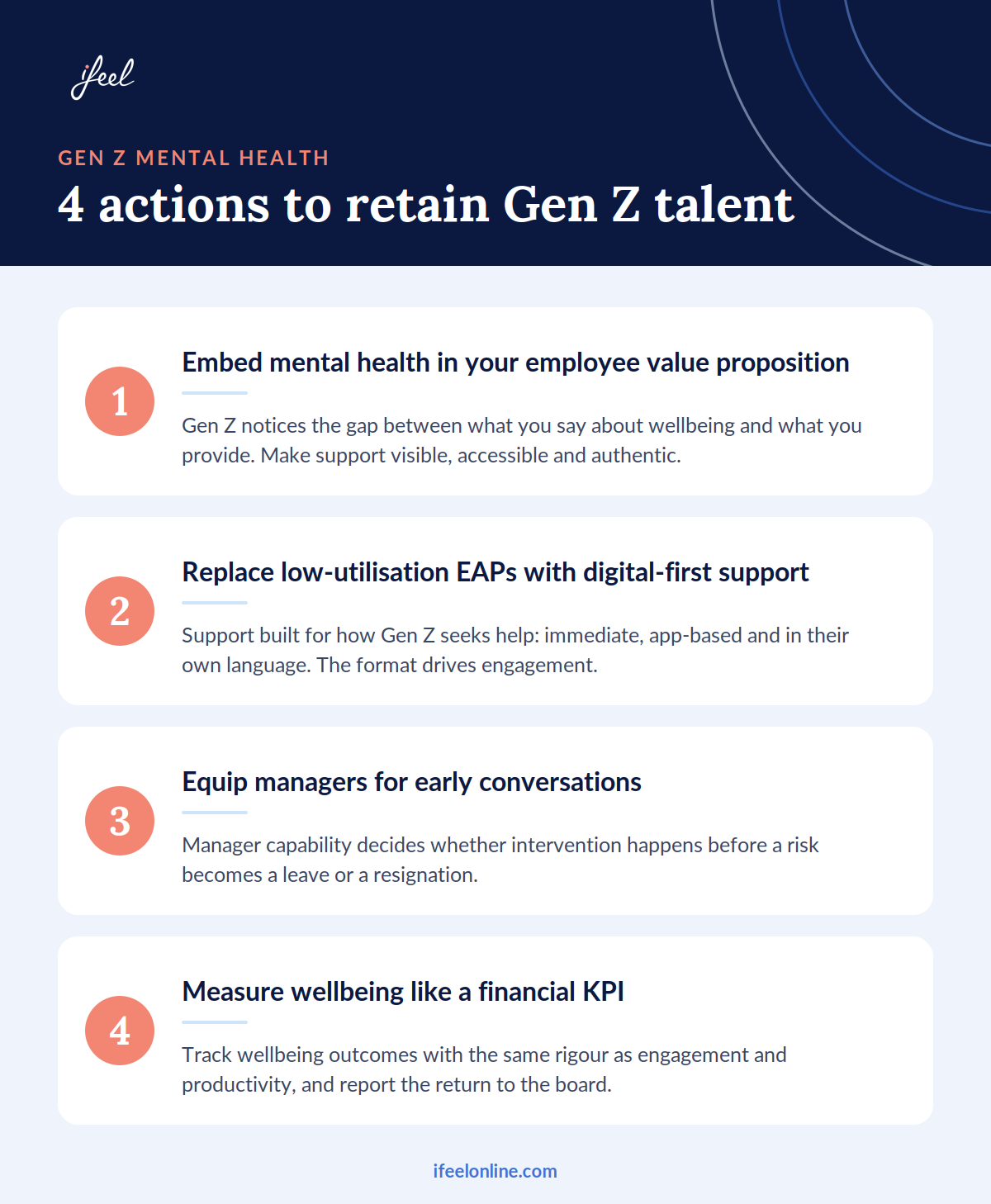
Embed mental health visibly into the employee value proposition. Gen Z notices the gap between what organisations say about wellbeing and what they actually provide. Authentic, accessible support — not a wellness app and an annual survey — is what builds trust with this cohort.
Replace low-utilisation EAPs with clinical-grade, digital-first platforms. The format of support matters as much as the content. Platforms that offer immediate access, multiple communication modalities, and multilingual coverage across 50+ languages remove the friction that keeps younger employees from seeking help early.
Equip managers to have early, confident conversations. Fewer Gen Z employees feel comfortable discussing stress with managers, signalling a gap between organisational awareness and actual support. Manager capability — not just employee access — determines whether early intervention happens before a risk becomes a leave or a resignation.
Measure what matters. Moving an employee from dissatisfied to satisfied with recognition is associated with a 20-percentage-point improvement in self-reported mental wellbeing. The organisations winning the Gen Z talent competition are the ones tracking wellbeing outcomes with the same discipline they apply to engagement scores and productivity metrics.
The cost of inaction: what the turnover data tells CHROs
Voluntary turnover is the most quantifiable consequence of getting Gen Z mental health wrong. Unlike previous generations, Gen Z does not consider organisational loyalty a given in exchange for employment. 83% of Gen Z workers consider themselves to be job-hoppers, and burnout sits at the top of their reasons for moving on.
58% of Gen Z say burnout is a top driver of job dissatisfaction, and they are more likely to leave roles that lack flexibility, caregiver support, or mental health resources. When burnout is the driver, the cost of replacement accumulates quickly across recruiting, onboarding, and the productivity gap during transition. For mid to senior roles, that figure routinely reaches 50 to 200% of annual salary. The full financial picture of absenteeism and presenteeism makes the case for early investment even clearer.
The inverse case is equally compelling. 55% of Gen Z employees are more likely to stay with employers who provide meaningful mental health support. For organisations with large Gen Z cohorts, the ROI of investing in accessible, high-quality mental health support is not theoretical. It is calculable, quarter by quarter.
Gen Z mental health: from challenge to strategy — a summary
| Challenge | Business impact | Strategic response |
|---|---|---|
| 72% of Gen Z report burnout symptoms (Seramount, 2025) | Elevated absenteeism risk, disengagement, and turnover intent | Prevention-first mental health programme with early intervention |
| 61% would leave for better mental health benefits (SHRM) | Direct talent retention and acquisition risk | Mental health embedded in employee value proposition |
| EAP utilisation below 5% across traditional providers | Support investment wasted; Gen Z cohort unsupported | Digital-first platform with 10x EAP engagement (ifeel) |
| 83% consider themselves job-hoppers | High replacement cost and pipeline disruption | Sustained, measurable wellbeing strategy with tracked ROI |
Frequently asked questions: Gen Z mental health at work
Why is Gen Z experiencing higher burnout than previous generations?
Gen Z workers are reporting some of the highest burnout levels ever recorded. Burnout is more likely to occur when there is a growing mismatch between expectations of work and its actual realities. For Gen Z, this mismatch is amplified by financial insecurity, the legacy of entering the workforce during the pandemic, and workplace cultures that have not adapted to their mental health expectations. The result is a generation burning out earlier and leaving faster than those before them.
What do Gen Z employees actually want from mental health support at work?
Mental health benefits are particularly valued by Gen Z and younger employees. Spring Health’s 2026 Workplace Mental Health Annual Report found that 69% of employees said mental health benefits are extremely or very important to them when making job decisions. Gen Z specifically wants digital-first access, immediate availability, and support delivered without stigma — on their own terms and in their own time.
Does investing in Gen Z mental health actually improve retention?
Yes — the data is clear. Mental health support is a competitive advantage for attracting and retaining emerging talent. While Gen Z has brought these expectations to the forefront, all employees benefit from workplaces that genuinely prioritise mental wellbeing. Organisations that deliver measurable mental health support consistently report stronger retention rates, higher engagement scores, and lower recruitment spend.
Why do traditional EAPs fail to support Gen Z employees?
Traditional EAPs suffer from a fundamental format mismatch. They are often characterised by prolonged wait times, limited engagement options, and a lack of culturally competent care, resulting in low utilisation rates and suboptimal clinical outcomes. Gen Z, which overwhelmingly prefers virtual care and expects on-demand access, will not engage with a service built for a different era.
How does ifeel support organisations with Gen Z retention challenges?
ifeel combines clinical-grade mental health support with a digital-first platform designed for how modern employees actually seek help. With a network of 1,000+ licensed psychologists across 90+ countries in 50+ languages, and a guaranteed adoption rate of 20%+ from day one, ifeel closes the utilisation gap that renders traditional EAPs ineffective. ifeel’s Verity product gives HR leaders anonymised, real-time insights into engagement, wellbeing risk, and emerging trends by team, department, and demographic — enabling CHROs to act on data rather than intuition. The result: a 3x ROI within 12 months and a 30%+ reduction in mental health-related absenteeism risk.
Why ifeel is the partner you need
Gen Z is not a difficult generation. They are a clear-eyed one. They know what good mental health support looks like because they have experienced what happens in its absence. The organisations that close the gap between what Gen Z expects and what they currently receive will build the workforce advantage that defines the next decade.
ifeel delivers the clinical depth, digital accessibility, and measurement infrastructure that makes that possible. With engagement rates 10x higher than traditional EAPs, a guaranteed adoption rate of 20%+, and a 3x ROI within 12 months, ifeel turns a talent retention challenge into a measurable business outcome. Our Verity platform gives CHROs the population-level insight to identify where Gen Z wellbeing is deteriorating before it becomes absenteeism or attrition — and the evidence base to make the investment case to the board. For a broader view of what a mentally healthy organisation looks like in practice, the strategic framework starts here.
Mental health support is no longer a differentiator for Gen Z. It is a baseline expectation. The question is not whether to provide it. It is whether your current provision is actually reaching the people who need it most.
Get in touch with our team to find out how ifeel helps CHROs turn Gen Z wellbeing into a strategic retention advantage.
Leadership lens 🔍
Gen Z burnout is not an HR problem. It is a succession risk. As this cohort grows to represent 30% of the global workforce by 2030, their attrition rate today determines your talent pipeline tomorrow. C-suite leaders who frame Gen Z mental health support as a cost overlook the compounding expense of replacing them. The organisations building durable competitive advantage are treating wellbeing investment as capital allocation, with measurable returns on retention, productivity, and organisational resilience. The data makes the case. The decision rests with leadership.