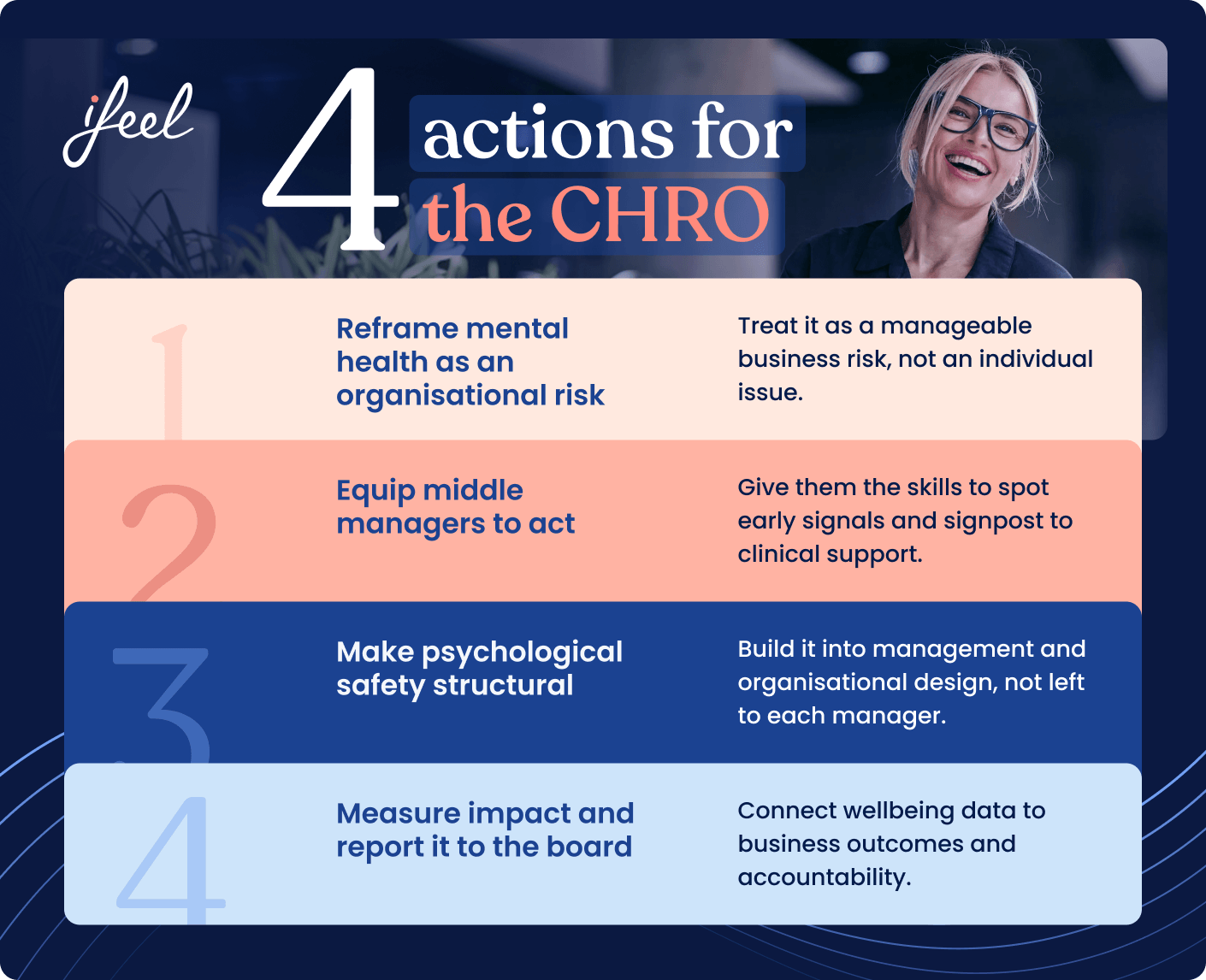
The CHRO’s role has fundamentally changed. Where once the function was measured by operational efficiency and compliance, today’s Chief Human Resources Officer is expected to deliver something far more complex: a psychologically safe, high-performing organisation that can absorb disruption without breaking. Mental health sits at the centre of that mandate, not as a benefits line item, but as a strategic lever for resilience, retention, and measurable financial return. Building a mentally healthy organisation requires CHROs to act on four fronts simultaneously: reframing mental health as a business risk, embedding it into organisational design, equipping leaders to act, and measuring outcomes with the same rigour applied to any financial investment. This article sets out the evidence for why this matters and what the most effective CHROs are doing about it.
Why the cost of inaction is no longer acceptable
The scale of the problem is not in question. According to the World Health Organisation, depression and anxiety cost the global economy US$1 trillion each year in lost productivity, driven by an estimated 12 billion working days lost annually. For most large organisations, a significant share of that cost lands inside their own payroll. Yet many leadership teams still treat mental health as a peripheral concern, something addressed by a benefits brochure rather than a board-level strategy.
The data on employee experience tells a sobering story. Workers who feel supported by their employer are 71% less likely to report burnout, three times more likely to be engaged, and 69% less likely to be actively seeking another job. Conversely, when that support is absent, the financial consequences compound quickly: higher mental health sick leave, reduced productivity, elevated turnover, and rising healthcare costs. In the UK alone, poor mental wellbeing costs employers an estimated £42–45 billion annually through presenteeism, sickness absence, and staff turnover.
The CHRO’s role is to make this visible to the board, in financial terms, and to design a response that goes beyond reactive support.

From personnel manager to people strategist: the CHRO’s evolving mandate
The transformation of the CHRO role is well underway. CHROs have become fundamental to business success, sitting at the intersection of business strategy, workforce planning, and talent development. They are no longer simply custodians of people processes. They are architects of organisational performance.
Mental health is now central to that architecture. According to a PwC Pulse Survey, 76% of CHROs are already enhancing mental health offerings as a direct response to workforce expectations. And Gartner’s 2025 CHRO Priorities research confirms that embedding culture into day-to-day work, which includes psychological safety, can increase employee performance by up to 34%.
This is not a soft skill agenda. It is a business imperative, and the CHRO is the executive best positioned and increasingly expected to lead it. CHROs’ responsibilities now extend to the centre of board strategic issues, including cultural transformation and the conditions that enable people to perform sustainably.
What a mentally healthy organisation actually looks like
A mentally healthy organisation is not one where no one is struggling. It is one where support is accessible, stigma is low, leaders are equipped to respond, and data informs decisions before problems escalate. It is characterised by psychological safety, the confidence that employees can speak up, ask for help, or flag a concern without fear of reprisal.
This matters because psychological safety is not just a cultural aspiration. It is an operational foundation. When it is absent, early warning signals go unreported, problems escalate to long-term absence, and the organisation loses its ability to self-correct. When it is present, teams perform better, adapt faster, and retain talent more effectively.
The CHRO’s role is to make psychological safety structural, not accidental. It must be built into management practices, performance frameworks, and leadership development, rather than left to the discretion of individual managers.
Four actions that define the most effective CHROs
Reframe mental health as an organisational risk, not an individual issue
The most significant shift a CHRO can make is to stop treating mental health as something that happens to individuals and start treating it as something that happens to organisations. When unmanaged psychosocial risk accumulates across a workforce, the consequences are systemic: higher mental health-related absenteeism risk, talent flight, reduced decision quality, and operational fragility.
This reframe changes the conversation at board level. Instead of presenting a wellbeing programme, the CHRO presents a risk management strategy, with a cost baseline, projected return, and measurable milestones. Organisations that make this shift move from reactive to preventive, from isolated initiatives to a model in which mental health is managed like any other critical business risk: with clinical criteria, committed response times, and metrics that connect directly to productivity and cost.
Equip middle managers to act, not just to signpost
Middle managers are the single most important variable in any mental health strategy. They are closest to early warning signs: declining performance, withdrawal, presenteeism, increased friction within teams. Yet most are not equipped to respond effectively. According to NAMI data, only 11% of workplaces require mental health training for managers, despite the fact that more than half of those who receive it report greater confidence in addressing mental health at work.
The CHRO must design a manager enablement programme that goes beyond a one-off workshop. This means equipping leaders with the skills to have difficult conversations, recognise early distress signals, and signpost to clinical support without overstepping. It also means ensuring that managers themselves are supported, since research shows that 72% of leaders in large companies have experienced mental health problems due to stress.
Make psychological safety structural, not aspirational
Psychological safety does not emerge from values statements or culture days. It is built through consistent leadership behaviours, clear reporting structures, and systems that reward candour over conformity. The CHRO’s role is to design the management environment in which psychological safety can take root, including performance review frameworks that do not punish vulnerability, anonymous feedback mechanisms, and explicit norms around acceptable workload and working hours.
This is also where the CHRO’s influence on organisational design matters most. Structure shapes culture. Flat, empowered team structures tend to produce greater psychological safety than rigid hierarchies. Flexible working arrangements, now a core expectation, directly affect mental wellbeing and should be treated as a structural, not discretionary, element of people strategy.
Measure impact and report it to the board
A mental health strategy without measurement is a gesture. The CHRO must establish a reporting framework that connects wellbeing data to business outcomes, quantifying the link between risk levels, absenteeism, engagement, and financial performance. This is both the strongest argument for investment and the strongest mechanism for accountability.
The right partner provides the data infrastructure to make this possible. ifeel Verity, ifeel’s AI-powered insights product, delivers anonymised dashboards showing engagement, risk movement, and mental health-related absenteeism risk trends by country, department, and business unit. This transforms wellbeing from an intuition into a boardroom metric and turns the CHRO into a strategic voice at the executive table.
The strategic case: what the numbers say
| Strategic outcome | Benchmark | ifeel impact |
|---|---|---|
| Mental health-related absenteeism risk | Industry average rising | 30%+ reduction in risk with ifeel partners |
| EAP engagement | 2–5% industry average | 10x higher with ifeel’s model |
| Return on investment | Variable | 3x ROI within 12 months |
| Employee NPS | 45 (industry benchmark) | 60 with ifeel |
The financial case for a proactive mental health strategy is clear. Organisations that invest effectively in mental health support can achieve a 30% or greater reduction in mental health-related absenteeism risk, and ifeel’s corporate partners consistently achieve a 3x return on investment within 12 months. For mid- and high-risk employees, the cost savings of early intervention range from 15,000 to 50,000 EUR per individual, making prevention not just the ethical choice, but the financially responsible one.
FAQ: what CHROs ask about building a mentally healthy organisation
What is the CHRO’s primary responsibility when it comes to mental health?
The CHRO is responsible for embedding mental health into organisational strategy, not just employee benefits. This means treating psychosocial risk as a manageable business risk, establishing data-driven measurement frameworks, equipping managers to support their teams, and ensuring that clinical support is accessible and adopted across the workforce. The goal is prevention at scale, not crisis response.
How do you build a business case for a mental health investment?
The business case rests on quantifying the cost of inaction. Mental health-related absenteeism, presenteeism, and turnover carry significant financial consequences, from direct payroll costs to recruitment expenses and lost productivity. By establishing a cost baseline and projecting intervention impact against that baseline, CHROs can present a compelling, financially grounded case to the board. ifeel’s analytical tools support this process with anonymised, real-time workforce data.
What is psychological safety, and why does the CHRO own it?
Psychological safety is the shared belief among team members that they can speak up, flag concerns, or admit difficulties without fear of negative consequences. It is a direct predictor of team performance, innovation, and retention. The CHRO owns it because it is determined by management practice, organisational design, and cultural norms, all of which sit within the CHRO’s mandate.
How does ifeel support CHROs in building a mentally healthy organisation?
ifeel provides CHROs with a clinically validated, enterprise-ready mental health platform covering 90+ countries and 50+ languages. With a network of 1,000+ licensed psychologists, engagement rates 10x higher than traditional EAPs, and guaranteed adoption above 20%, ifeel gives CHROs both the clinical infrastructure and the data tools to turn wellbeing strategy into measurable business outcomes. ifeel Verity, ifeel’s AI-powered insights product, delivers the real-time organisational intelligence that leaders need to act early and act effectively.
What is the difference between a wellness programme and a mental health strategy?
A wellness programme offers benefits: apps, helplines, occasional workshops. A mental health strategy embeds clinical rigour, proactive risk management, and measurable outcomes into the operating model. The distinction matters because programmes with low adoption and no measurement generate no return. A strategy built around prevention, early intervention, and data-informed decision-making delivers sustained impact on performance, retention, and cost.
Why ifeel is the partner you need
Building a mentally healthy organisation is not a project with a start and end date. It is an ongoing capability, one that requires clinical expertise, global infrastructure, and the kind of data intelligence that links wellbeing to financial performance in real time.
ifeel delivers on all three. With a network of over 1,000 licensed psychologists operating across 90+ countries in 50+ languages, and engagement rates 10x higher than traditional Employee Assistance Programmes, ifeel gives CHROs a solution that employees actually use. Guaranteed adoption above 20% and an NPS of 60, compared to the industry benchmark of 45, mean the investment translates into measurable outcomes, not just offering statements. The 3x ROI delivered within 12 months, and savings of 15,000 to 50,000 EUR per mid- or high-risk employee, make the financial case compelling at board level.
ifeel Verity, ifeel’s AI-powered insights product, adds the organisational intelligence layer that modern CHROs need: real-time, anonymised dashboards that connect clinical risk to absenteeism, engagement, and performance data, segmented by country, department, or business unit.
Mental health is no longer a peripheral concern for the CHRO. It is the strategic foundation on which resilient, high-performing organisations are built.
Get in touch with our team to find out more.
Leadership Lens
The CHRO’s capacity to build a mentally healthy organisation is ultimately a test of organisational resilience. Boards and CEOs increasingly evaluate people strategy through the same lens as financial risk: can the organisation sustain performance under pressure, absorb disruption without fragility, and retain the talent that strategy depends on? Mental health is not separate from that question. It is central to it. CHROs who embed clinical-grade mental health infrastructure into their operating model are not just improving employee experience. They are protecting the organisation’s ability to execute, innovate, and grow.