Workplace functioning and mental health don’t always move together: many corporate wellbeing programmes measure success by asking whether an employee’s anxiety or low mood has gone down. That’s useful information, but it’s incomplete. An employee can report fewer symptoms and still be unable to concentrate, meet deadlines, or interact with their team as usual.
Improving workplace functioning and mental health means adding a functioning scale alongside symptom measures, distinguishing between the two types of risk, adapting the therapy channel to each profile, and adjusting recovery expectations depending on whether the risk is functional or symptomatic.
That distinction matters a great deal for HR and for those responsible for workplace mental health. Understanding the difference between symptomatic risk and functional risk allows companies to design wellbeing programmes that genuinely restore people’s ability to work, rather than simply lowering a number on a questionnaire.

Why isn’t measuring anxiety and depression symptoms enough?
Symptom questionnaires, such as the PHQ-9 for depression or the GAD-7 for anxiety, are validated and highly useful tools for detecting emotional distress. However, they measure how a person feels, not how they function day to day.
Workplace and social functioning, by contrast, is part of what we mean by employee wellbeing, and is assessed using scales such as the SOFAS (Social and Occupational Functioning Assessment Scale), which directly measures a person’s ability to carry out their tasks, maintain relationships and sustain their routine, regardless of how many symptoms they report.
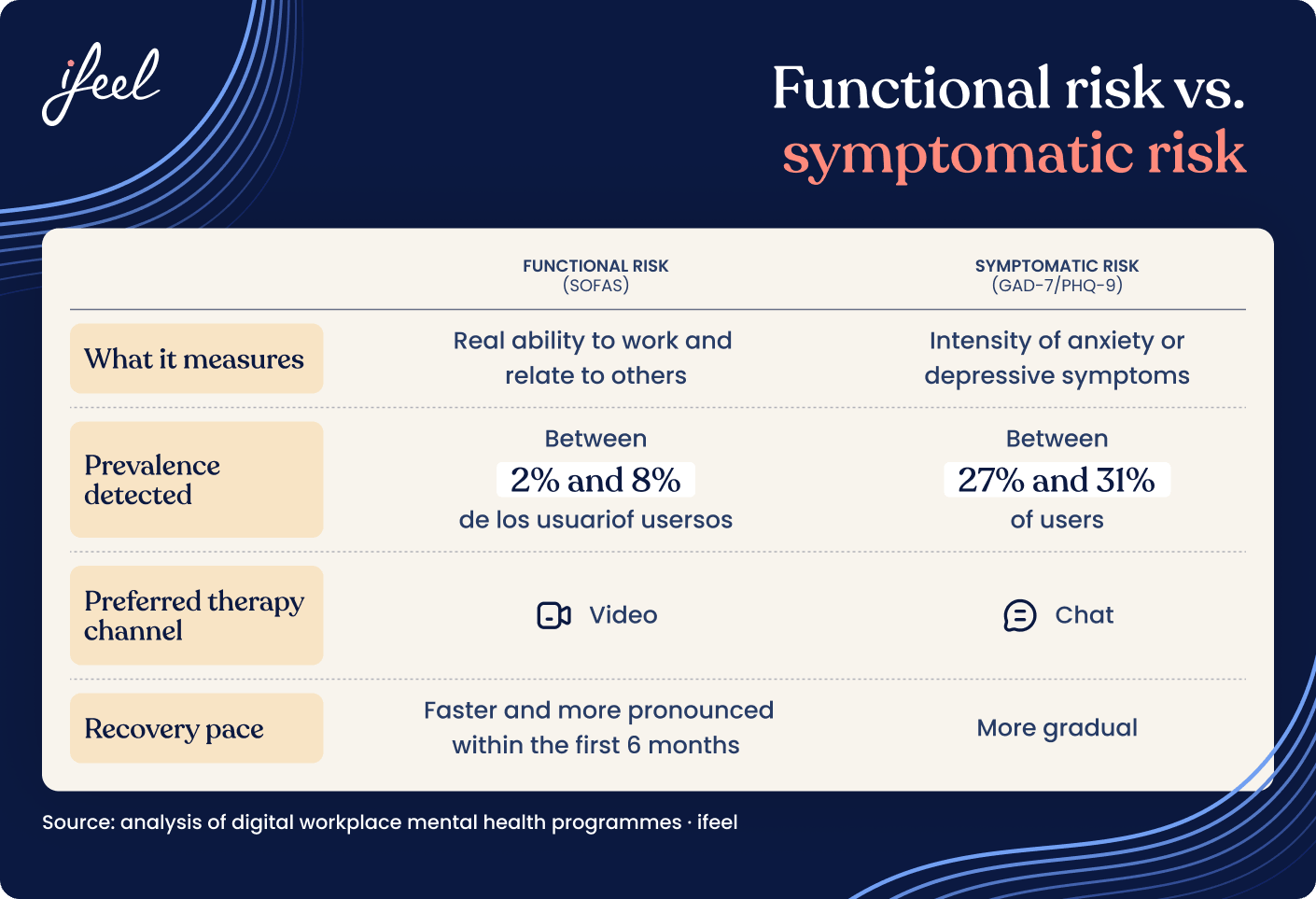
A recent analysis of digital mental health programmes in the workplace showed that these two types of risk identify, to a large extent, different populations: between 2% and 8% of users were identified as high-risk by functional criteria (SOFAS), compared with 27–31% identified by symptomatic criteria (GAD-7/PHQ-9). These are groups that only partly overlap, with different demographic profiles and recovery patterns.
How to build workplace functioning into your mental health programme
Moving from a model focused solely on symptoms to one that also measures employees’ real functioning requires a few concrete adjustments. Here are the main steps.
Step 1: Add a functioning scale, not just a symptom scale
If your current wellbeing programme only uses anxiety or depression questionnaires, add a measure of social and occupational functioning. This makes it possible to detect employees who, even without extreme emotional symptoms, show meaningful impairment in their ability to work.
Step 2: Understand that symptomatic risk and functional risk are not the same
Don’t assume both indicators identify the same people. The data shows these are populations that only partly overlap, with different demographic profiles. Treating them as equivalent can leave a significant group of employees without the right level of attention.
Step 3: Don’t confuse symptom improvement with a return to full performance
An employee may report less anxiety or low mood and still need support to regain their usual workplace functioning. Track workplace functioning over time before closing out a case.
Step 4: Adapt the therapy channel to the type of risk
Employees with greater functional impairment tend to show a marked preference for video therapy, while profiles with predominantly symptomatic risk tend to make more use of chat-based support. Matching the available channel to each profile improves treatment adherence.

Step 5: Adjust recovery expectations depending on the type of risk
Functional-risk cases generally show a more pronounced recovery within the first six months than cases with predominantly symptomatic risk, whose improvement tends to be more gradual. Communicating this difference to managers helps avoid unfair comparisons between employees.
Step 6: Train managers to spot signs of functional decline
An employee may never put anxiety or sadness into words and still show clear signs of declining workplace functioning: recurring errors, withdrawing from the team, missed deadlines. These are patterns already well documented around burnout at work. Training managers to recognise them, beyond the purely emotional, improves early detection.
Step 7: Use both indicators to calibrate the intensity of support
Combining symptomatic and functional data gives a far more complete picture of the level of support each employee needs, and allows clinical resources to be allocated with greater precision.
A quick comparison: functional risk and symptomatic risk
| Aspect | Functional risk (SOFAS) | Symptomatic risk (GAD-7/PHQ-9) |
|---|---|---|
| What it measures | Real ability to work and relate to others | Intensity of anxiety or depressive symptoms |
| Prevalence detected | Between 2% and 8% of users | Between 27% and 31% of users |
| Preferred therapy channel | Video | Chat |
| Recovery pace | Faster and more pronounced within the first 6 months | More gradual |

Why ifeel is the partner you need to measure workplace functioning, not just symptoms
Workplace mental health is a global business challenge, and wellbeing programmes that only measure symptoms offer an incomplete picture of what’s really happening within the workforce and its workplace functioning. For a wellbeing programme to have a real, measurable impact, it needs to combine the emotional perspective with the functional one.
At ifeel, we designed our mental health solution for companies precisely on that basis: we combine validated symptom scales with social and occupational functioning assessments, carried out by our clinical team, to give HR a complete view of each case. Our network of more than 600 professionals and our data-driven approach allow us to adapt the channel and the intensity of support to each risk profile.
For organisations that want to go beyond symptom reduction and restore their teams’ real ability to work, measuring workplace functioning is the natural next step. Get in touch with our team to find out more.
Leadership lens 🔍
Reducing an employee’s anxiety or low mood doesn’t guarantee they’ll regain their ability to perform at work: the data shows that functional risk and symptomatic risk largely affect different populations, with different recovery paces and different support needs. For leadership, this means a robust mental health programme can’t be judged on symptom reduction alone — it also needs to measure whether people are genuinely regaining their day-to-day functioning, which is, ultimately, what sustains the business’s productivity.