Mental health budget planning is where, at the end of the budget cycle, organisations that control their risk part ways with those that simply inherit it. The World Health Organization and the International Labour Organization estimate that 12 billion working days are lost every year to depression and anxiety, at a cost of nearly US$1 trillion in lost productivity (WHO, 2022). For CHROs this is not a wellbeing line item. It is a risk control decision, and it must be closed before the CFO locks the numbers.
A corporate mental health budget funds detection, access to clinical care, measurement and data governance. It is defended on risk avoided, not on benefits offered. To secure approval, the CHRO must close five decisions in this order: scope, provider, metrics, communication and data governance. Each one must reach the approval meeting documented, with a prepared answer for the CFO and a default option.

Causes and hidden cost: why mental health budgets are approved badly
In most organisations, the mental health budget is approved on autopilot. The EAP is renewed, the figure is uplifted for inflation and the committee moves on to the next line. This is not a spending problem. It is a judgement problem.
Budgeting on autopilot means not knowing what you are buying. Nobody knows how many people use the service, how long they wait for care or what happens to the most serious cases. The spend is real. The risk remains unmanaged.
The real cost never shows up in the mental health line. It shows up elsewhere:
- Sickness absence: absences that drag on because treatment arrives too late.
- Presenteeism: people who stay at their desks while performing well below their capacity.
- Undetected medium and high risk cases: the most expensive cases and the least visible ones.
According to ifeel data, the cost associated with each medium/high risk employee managed in time ranges from €15,000 to €50,000. That is the exposure attached to every case your organisation fails to detect.
There is a third cause, and it is the most avoidable: timing. Whatever is not decided before the budget round closes reaches the budget as an unsupported estimate. And unsupported estimates are the first to be cut.

The ifeel approach: clinical triage, validated scales and measurement with ifeel Verity
ifeel does not start from a catalogue of services. It starts from a clinical assessment.
AI-assisted clinical triage takes people from diagnosis to treatment in 1 to 24 hours. Behind it are more than 1,000 psychologists in more than 90 countries and more than 50 languages, so international workforces are covered by a single model.
Assessment relies on validated scales: PHQ for depression, GAD for anxiety, WSAS for functional impairment and SOFAS for social and occupational functioning. Each person is classified by risk level, and the intensity of care is matched to that level.
ifeel Verity turns that clinical activity into management information. It measures and reports in aggregated, anonymised form, without exposing any individual employee. Results are measurable within 6 to 12 months.
Mental health budget planning checklist: the five decisions to close
Each decision follows the same format: what must be closed, what the CFO will ask and which default option to take if there is no consensus. This is the wellbeing plan for next year that your executive committee needs to see before it signs off.
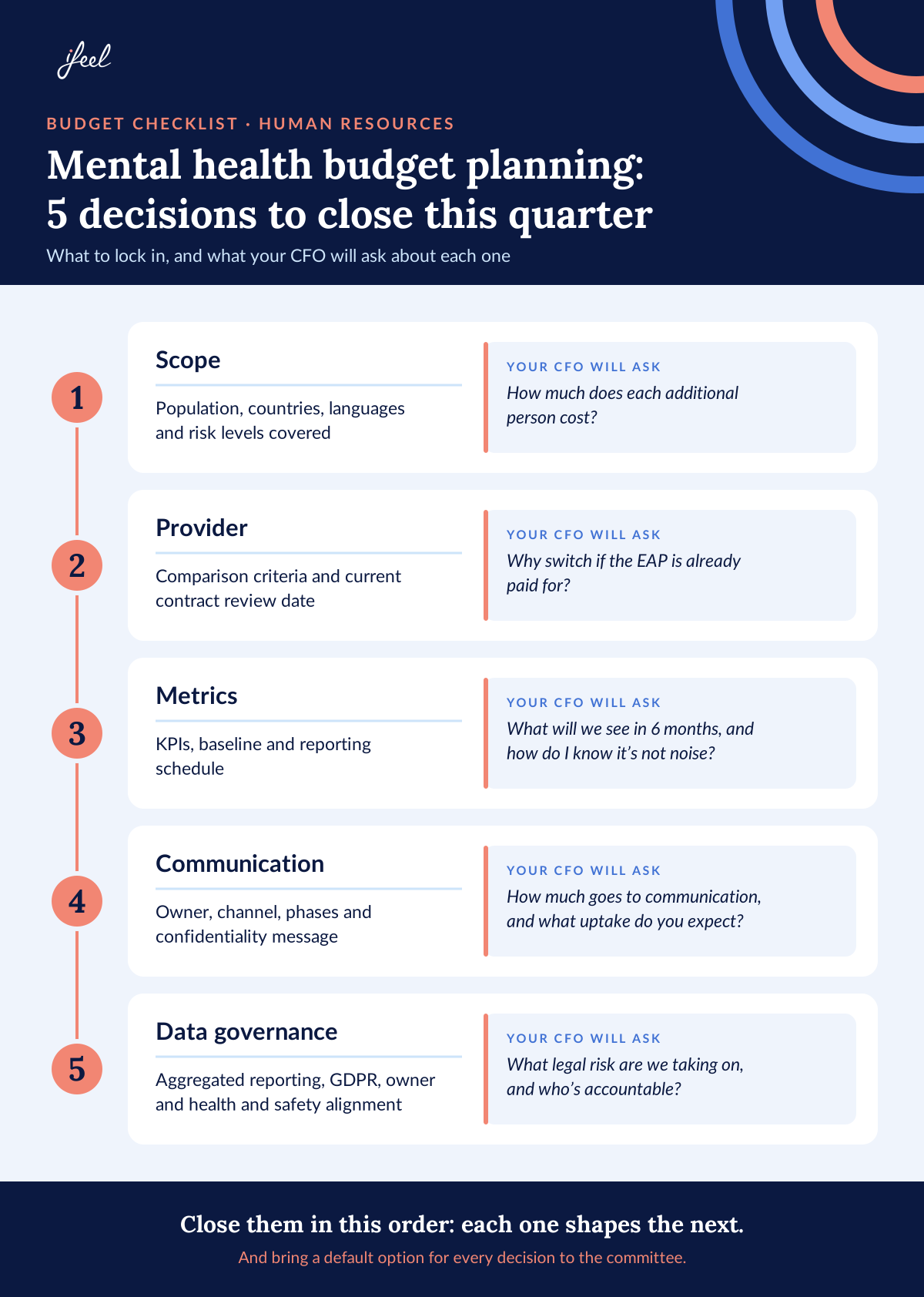
Decision 1: scope, who you cover and at what risk level
Scope sets the cost of mental health budget planning. Without a closed scope, there is no defensible figure.
- Close: population covered (workforce, countries, languages), whether family members are included and which risk levels are treated.
- CFO question: “How many people are we covering, and what does each additional person cost?”
- Default: the whole workforce, with clinical priority for medium-high and high risk levels.
Decision 2: provider, traditional EAP or clinical triage
Renewing is not deciding. Comparing on data is.
- Close: comparison criteria (adoption, time to access, clinical profile and country coverage) and the review date of the current contract.
- CFO question: “Why switch if the current EAP is already paid for?”
- Default: a short extension with an exit clause while you compare on real data. As a benchmark, ifeel records 10x engagement compared with traditional EAPs, average adoption above 20% and an NPS of 60 against a sector average of 45.
Decision 3: metrics, what you take to the committee and when
What is not measured cannot be defended in the next financial year.
- Close: adoption, NPS, distribution by risk level and sickness absence, with a baseline and a reporting calendar.
- CFO question: “What will we see in six months, and how do I know it is not noise?”
- Default: set the baseline now and report quarterly, with sickness absence broken down by risk level. For mental health, ifeel records a reduction of more than 30% in absence risk in high risk cases and mid-high risk cases. This figure applies to those cases specifically, not to the workforce as a whole.
Decision 4: communication, how you launch without stigma
A programme nobody uses is a cost, not an investment.
- Close: owner, channel, timeline and confidentiality message, aligned with the contract start date.
- CFO question: “How much goes on communication, and what adoption do you expect?”
- Default: a two-phase launch, first senior leaders and line managers, then the wider workforce, with a minimum budget ring-fenced from day one.
Decision 5: data governance, what the organisation sees and what it does not
Employee trust depends on this decision. Adoption depends on trust.
- Close: treatment of health data as special category data under UK GDPR and EU GDPR, aggregated and anonymised reporting only, an internal programme owner and alignment with your health and safety obligations, including stress risk assessment as expected by the Health and Safety Executive in the UK.
- CFO question: “What legal risk are we taking on, and who is accountable?”
- Default: aggregated reporting with a minimum group size, signed off by the data protection officer and legal before contract signature.
Checklist summary: what to close, what the CFO will ask and which default to take
| Decision | What must be closed and documented | CFO question and default option |
|---|---|---|
| Scope | Population, countries, languages and risk levels | “What does each additional person cost?” Default: whole workforce, prioritising medium-high and high risk |
| Provider | Comparison criteria and contract review date | “Why switch?” Default: short extension with an exit clause |
| Metrics | Indicators, baseline and reporting calendar | “What will we see in six months?” Default: quarterly reporting from the baseline, with sickness absence broken down by risk level |
| Communication | Owner, channel, phases and confidentiality message | “What adoption do you expect?” Default: two phases with a ring-fenced minimum budget |
| Data governance | Aggregated reporting, GDPR basis, owner and health and safety alignment | “Who is accountable for legal risk?” Default: sign-off by the data protection officer and legal before signature |
Frequently asked questions about mental health budget planning
When should mental health budget planning be closed?
Mental health budget planning should be closed before the executive committee approves next year’s budget, whenever your financial year starts. The five decisions (scope, provider, metrics, communication and data governance) must be documented before that meeting. Anything that arrives without evidence is cut first. That is why the CHRO’s decisions in the final quarter of the budget cycle shape the outcome of the entire year.
How do you justify mental health investment to the CFO?
You justify it on risk avoided, not on wellbeing. According to ifeel data, the cost associated with each medium/high risk employee managed in time ranges from €15,000 to €50,000. The cost of sickness absence and presenteeism comes on top of that figure. In financial terms, prioritising mental health investment means reducing exposure to a cost the organisation is already carrying.
What is the difference between renewing an EAP and adopting a clinical triage model?
A traditional EAP is measured on availability: the service exists, whether or not anyone uses it. A clinical triage model is measured on access and outcome. With ifeel, people move from diagnosis to treatment in 1 to 24 hours, with validated scales and reporting by risk level. Engagement is 10x higher than with traditional EAPs.
Which metrics should the CHRO take to the executive committee?
The CHRO should report adoption, NPS, distribution by risk level and sickness absence, always against a baseline. Results are measurable within 6 to 12 months. Sickness absence must be read by risk level: for mental health, ifeel records a reduction of more than 30% in absence risk in high risk cases and mid-high risk cases. Quarterly reporting allows course correction before the next financial year.
How is the confidentiality of mental health data protected?
Health data is special category personal data under UK GDPR and EU GDPR. The organisation should only ever receive aggregated, anonymised information, never individual data. Reporting must apply a minimum group size to prevent identification. The internal programme owner and the data protection officer’s sign-off must be agreed before the contract is signed.
Why ifeel is the partner your organisation needs
Your organisation does not need another service that simply exists. It needs a model that detects, treats and measures.
- More than 1,000 psychologists in more than 90 countries and more than 50 languages.
- 10x engagement compared with traditional EAPs.
- Average adoption above 20%.
- NPS of 60 against a sector average of 45.
- A reduction of more than 30% in absence risk in high risk cases and mid-high risk cases for mental health.
- AI-assisted clinical triage, from diagnosis to treatment in 1 to 24 hours.
- Validated scales: PHQ, GAD, WSAS and SOFAS.
- Measurable results within 6 to 12 months.
ifeel Verity turns mental health into data your executive committee and your CFO can audit, without exposing any employee. Your mental health budget stops being a line of faith and becomes a line of control.
The question is not whether your mental health budget planning can wait until next financial year, but whether your organisation can afford to approve it without closing these five decisions.
Request information and take five closed decisions to your budget committee.
Leadership lens 🔍
The mental health budget is defended as risk control and business continuity, not as a benefit. One quarter is enough to close all five decisions, provided they are taken in order: scope, provider, metrics, communication and governance. It requires a baseline, a reporting calendar of 6 to 12 months and a guarantee that no individual data ever reaches the organisation. What is not decided now is paid for later, in sickness absence.