Returning from parental leave is not a date in the HR calendar. It is one of the highest-risk moments in the employee lifecycle. Every month, part of your workforce returns with a new routine, less sleep and a team that has moved on without them. For CHROs, this is not an administrative milestone. It is a process that demands clinical and practical preparation: criteria to detect distress, an agreed return plan, line managers with clear guidance and confidential access to psychological support before the person comes back. Your HR function cannot improvise it.
Returning from parental leave is the process by which an employee goes back to work after time off for the birth and care of a child. It is a moment of risk for both wellbeing and retention. It requires a clear plan, up-to-date information from day one, structured follow-up and confidential access to psychological support where needed. It affects the whole workforce, not only mothers. Across the EU, Directive (EU) 2019/1158 on work-life balance sets a minimum of 10 working days of paid paternity leave and 4 months of parental leave per parent. Returning from maternity leave and returning from paternity leave are therefore the same management challenge.
Why returning from parental leave is now a board-level issue
This is not a scheduling question. It is a risk management question.
The regulatory landscape has changed the size of the problem. In the EU, Directive (EU) 2019/1158 establishes a minimum of 10 working days of paid paternity leave and 4 months of parental leave per parent, 2 of which are non-transferable. In the UK, eligible employees can take up to 52 weeks of statutory maternity leave, and parents can share up to 50 weeks through shared parental leave. Since April 2024, protection from redundancy for returning parents extends to 18 months after birth.
The consequence is direct. You are no longer dealing with a niche group. You are dealing with anyone in your workforce of parenting age, in every country where you operate and at every level of the organisation, including your leadership pipeline.
Every poorly managed return is a breaking point. It damages the individual’s career, team continuity and succession in critical roles. That is why the decision does not sit with HR administration alone. It sits with the leadership team.
Causes and hidden cost of a poorly managed return from parental leave
The causes are rarely individual. They are organisational:
- There is no agreed return-to-work plan.
- Information on team changes, roles or priorities is out of date.
- There is no clear point of contact in HR.
- Line managers have no guidance.
- Nobody prepares the first day back.
The outcome is predictable. The person returns disoriented and without reference points. They try to compensate alone, in silence and under more pressure than necessary.
The hidden cost comes later. First comes presenteeism: the person is there, but not performing. Then comes subsequent sickness absence. Finally, talent loss and a broken leadership pipeline. Retention after parental leave is lost in the first months, not on the first day.
This is not an adjustment problem. It is a late detection problem.
And the cost does not stay with the individual. The WHO estimates that 12 billion working days are lost every year to depression and anxiety, at a cost of US$1 trillion in lost productivity. ifeel data puts the cost associated with each medium or high-risk employee managed in time at €15,000 to €50,000. Early detection is not an additional expense. It is how you contain a cost that does not yet appear on your P&L.
Three phases to manage returning from parental leave without losing talent
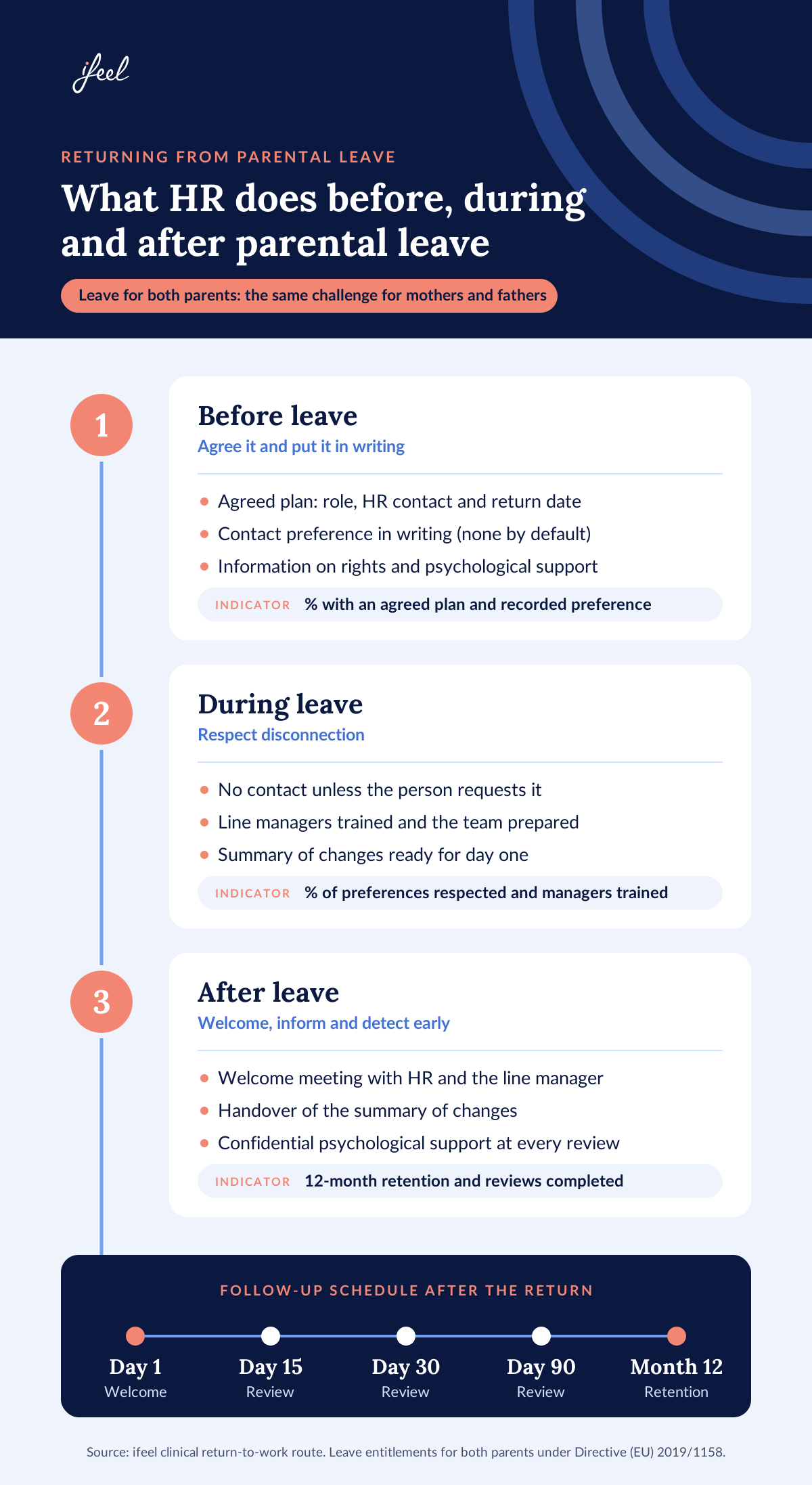
Before leave: agree the plan and set clear rules
HR meets the employee before they go on leave and records in writing their preference on contact during their absence. By default, there is no contact. Contact only happens if the person expressly requests it, in which case the channel, frequency and scope are agreed.
In that same meeting, the return plan is finalised: role and responsibilities, the named HR contact, the date and format of the return, and what information the person will receive before day one. The employee leaves with everything in writing.
They also receive information on their rights on return and on confidential access to psychological support, with an explicit message: the programme is for everyone, women and men alike. Legal obligations vary by country and require prior legal review.
During leave: respect disconnection and only make contact on request
The organisation does not make contact, does not send work communications and does not ask the person to check in, unless they have expressly requested otherwise. The leave belongs to them and they take it without interference.
Where contact has been requested, it is limited to the agreed channel and content. If the person changes their mind, HR records it and respects it.
Meanwhile, the organisation does its own work. Line managers are trained: they do not make contact on their own initiative, they know the plan and they prepare the team for the return. A summary of relevant changes is ready to hand over on the first day back.
After leave: welcome, inform and detect early

Day one starts with a welcome meeting with HR and the line manager. The summary of changes to the team, projects, tools and priorities is handed over, responsibilities are confirmed and the follow-up schedule is set.
In the following weeks, HR holds reviews at 15, 30 and 90 days using a common checklist. Workload and organisation are adjusted where needed. Access to confidential psychological support is reiterated at every review, without pressure and without questions about the person’s health.
Clinical return-to-work framework
| Phase | HR action and clinical support | Indicator to track |
|---|---|---|
| Before leave | Return plan, contact preference recorded (no contact by default), information on rights and confidential access to psychological support | Percentage of employees with an agreed plan and recorded preference |
| During leave | No contact unless expressly requested, line manager training and summary of changes prepared for the return | Percentage of contact preferences respected and of managers trained |
| After leave | Welcome meeting, handover of the summary of changes and reviews at 15, 30 and 90 days | 12-month retention and completion of reviews |
Frequently asked questions about returning from parental leave
What does returning from parental leave involve and why does it matter for mental health?
Returning from parental leave means going back to work after time off for the birth and care of a child. It coincides with a profound change in routine and with a working environment that has moved on without the person. A lack of information about what happened during their absence creates disorientation and increases the risk of burnout if nobody supports the return. That is why it requires an agreed plan and psychological support that is accessible from day one.
What should HR do before, during and after parental leave?
Before leave, HR agrees the return plan and records the employee’s contact preference. During leave, HR makes no contact unless expressly requested and prepares line managers and the summary of changes. After leave, HR welcomes, informs and follows up with a trained line manager. Reviews at 15, 30 and 90 days make it possible to detect any difficulty in time.
Should the organisation contact the employee during parental leave?
No, unless the employee expressly requests it. HR records that preference before leave begins and respects it throughout the absence. Nobody in the organisation, including line managers, makes contact on their own initiative or asks the person to check in. The summary of changes is kept ready to hand over on the first day back.
How can distress be detected without invading privacy?
Detection is based on voluntary and confidential access to psychological support, never on questions from the line manager. Validated clinical scales such as PHQ, GAD, WSAS and SOFAS identify the level of risk with rigour. The organisation only sees aggregated and anonymised data, protected in line with GDPR and UK GDPR. At no point does it access individual health data.
Which indicators show that investment in returning from parental leave is paying off?
The key indicators are 12-month retention, absence rates, use of the support service and completion of the agreed reviews. In ifeel programmes, the reduction in absenteeism risk exceeds 30% in high-risk and medium-high-risk mental health cases. Results are measurable within 6-12 months. With this data, the return from parental leave stops being a perception and becomes a management metric.
Why ifeel is the partner your organisation needs
This is not a process problem. It is a clinical problem that needs a process. Returning from parental leave demands clinical rigour, international reach and data. ifeel delivers all three.
ifeel applies AI-assisted clinical triage, from diagnosis to treatment in 1-24 hours. The returning employee does not wait weeks to speak to a professional. They access a network of more than 1,000 psychologists in more than 90 countries and more than 50 languages, so you can apply the same route across your entire organisation.
Assessment is built on validated scales: PHQ for depression, GAD for anxiety, WSAS for work and social functioning and SOFAS for overall functioning. They are applied voluntarily and confidentially to anyone returning to work, whether mother or father.

ifeel Verity turns that information into measurement and tracking at aggregate level, with full confidentiality and health data protection in line with GDPR and UK GDPR. Your HR team sees trends, not individuals. With ifeel Verity, the return from parental leave stops being an administrative task and becomes a management metric you can take to your executive committee.
The results speak for themselves:
- 10x engagement compared with traditional EAPs and average adoption above 20%.
- NPS of 60 compared with an industry average of 45.
- More than 30% reduction in absenteeism risk in high-risk and medium-high-risk mental health cases.
- Measurable results in 6-12 months.
The question is not whether your organisation will manage returning from parental leave, but whether it will do so in time or only after it has lost talent.
Request information and discover how ifeel can support your people through every return to work.
Leadership lens 🔍
Returning from parental leave is a breaking point in your leadership pipeline, and it can be measured. With leave entitlements expanding for both parents across Europe, the risk cuts across your entire workforce. A clear plan and early detection cost less than replacing talent. The decision is to treat it as a clinical process with indicators, not as an administrative task.