Organisational change and mental health are now inseparable risk categories for any CHRO: 87% of HR leaders have conducted or plan layoffs in 2026, according to LHH research — and that figure does not account for the far larger number of organisations navigating mergers, restructuring, digital transformation, or rapid growth at the same time. Organisational change is now a near-permanent feature of large enterprise life. Yet most change management programmes have detailed workstreams for technology, process, and communication — and almost nothing for the mental health of the people living through the disruption. For CHROs and People leaders, this is not an oversight. It is a measurable financial risk.
Organisational change is one of the most significant, and most consistently underestimated, psychosocial risk events a workforce can experience. The uncertainty, role disruption, and trust erosion that accompany restructuring, M&A, or large-scale transformation do not stay neatly within a change management timeline — they accumulate in the mental health of your workforce, compound over months, and eventually surface as absenteeism, attrition, and productivity loss. The organisations that build resilience through change are the ones that treat mental health as a core workstream of every transformation programme, not a wellbeing add-on to be addressed when the dust settles.

Why organisational change is a mental health event — not just a business event
The research is unambiguous. Using employer-employee data linked to individual health records, a study published in Management Science documented that the incidence of stress, anxiety, depression, and psychiatric medication usage increase following mergers — and that these effects are prevalent among employees from both target and acquiring organisations, regardless of whether the firm is financially strong or weak. Organisational change affects mental health even when the business rationale is sound and the process is managed professionally.
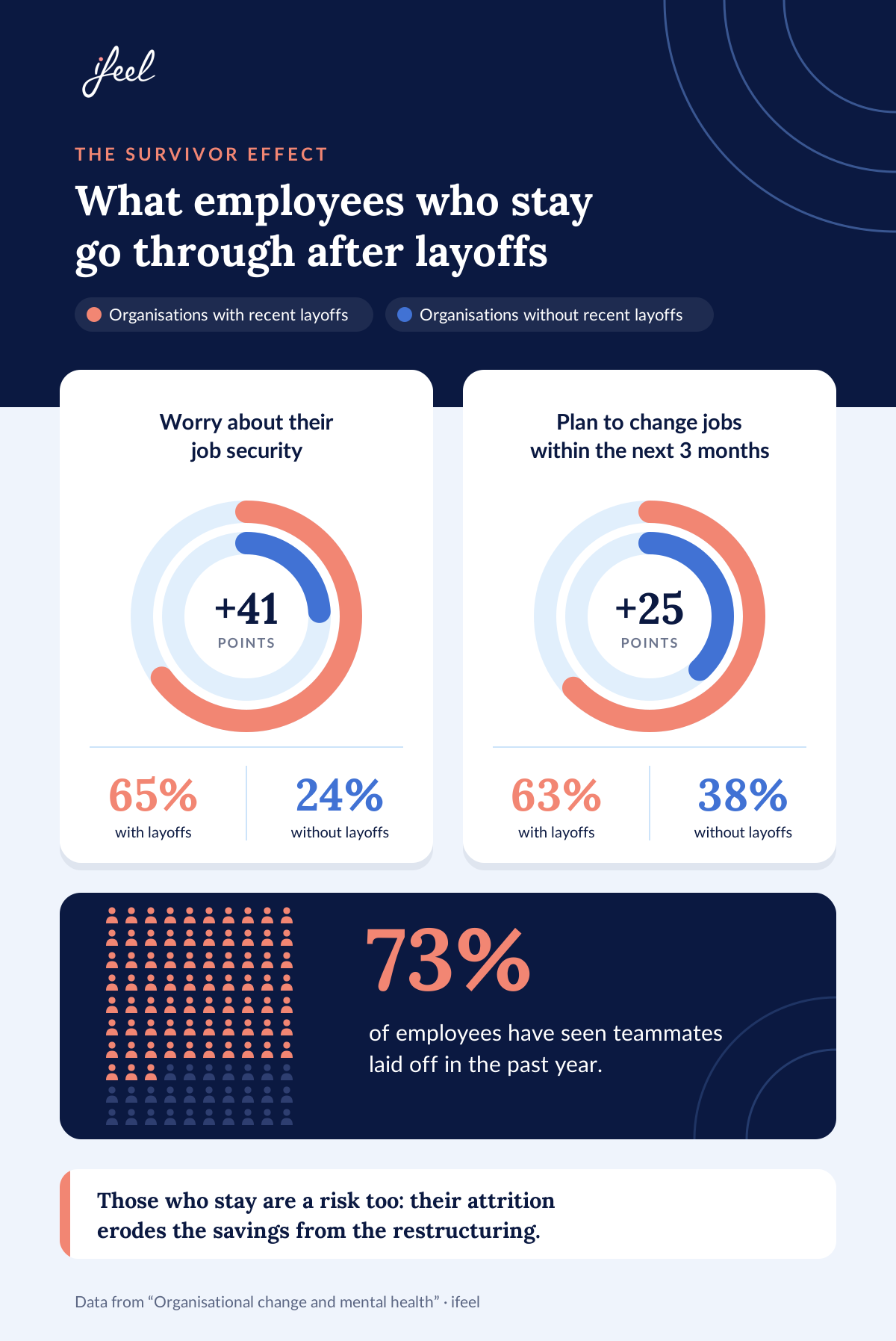
The impact extends well beyond those who lose their roles. 73% of employees had teammates laid off in the past year, with the top reported impacts on remaining employees including increased workload, reduced morale, instability, lost trust in leadership, and decreased productivity. These are the people who stay — and whose mental health, engagement, and performance determine whether the organisation successfully delivers on the transformation it undertook in the first place.
Job insecurity is the primary psychological mechanism. 54% of workers say job insecurity significantly impacts their stress levels, and among employees at organisations with recent layoffs, 65% worry about job insecurity compared to just 24% at organisations without recent layoffs. The anxiety of not knowing whether one’s role is safe generates the same neurological stress response as actual job loss — sustained over weeks or months, it produces the same clinical outcomes.
The survivor effect: the hidden cost most change programmes miss
The mental health impact of organisational change on employees who remain is consistently underestimated — and consistently more expensive than organisations expect. Research from the ILO confirms that workers exposed to restructuring were more likely to turn up for work while ill, had higher levels of sickness absenteeism, and reported significantly more stress than comparable workers in stable organisations.
The survivor effect operates through several mechanisms simultaneously. Workload increases as headcount decreases. Role clarity diminishes as responsibilities are reassigned. Trust in leadership erodes when communication is perceived as incomplete or delayed. Psychological safety — the belief that one can raise concerns or ask questions without professional consequences — drops sharply in environments of uncertainty. The result is a workforce that is physically present but functionally impaired: the definition of presenteeism at scale.
63% of workers at organisations with recent layoffs plan to look for a new job within three months, compared to only 38% at organisations without recent layoffs. The financial cost of that attrition — recruitment, onboarding, and lost institutional knowledge — routinely exceeds the savings generated by the restructuring itself. The mental health of your workforce during change is not a pastoral concern. It is a financial risk that should appear on every transformation business case.
The four change events that carry the highest mental health risk
Not all organisational change carries equal psychosocial risk. CHROs should apply differentiated mental health protocols to four distinct change event types.
Redundancies and workforce reductions. The highest acute stress event. Both departing employees and those who remain require structured support. Departing employees face identity disruption, financial anxiety, and grief. Remaining employees face survivor guilt, workload surge, and role uncertainty — often without any formal support, because the organisation’s attention is focused on the employees leaving. Mental health support during redundancy is a clinical obligation, not a communication exercise.
Mergers and acquisitions. M&A creates prolonged uncertainty — often extending over 12 to 24 months of integration — during which employees from both organisations navigate dual cultures, unclear reporting lines, and repeated rumours about further changes. The research documents that anxiety increases from 18.3% to 40.8% immediately following a merger announcement. Early, proactive clinical intervention at the announcement stage prevents acute stress from becoming chronic impairment.
Digital transformation and AI-driven change. AI anxiety at work is now formally recognised by EU-OSHA as an emerging psychosocial risk. 43% of middle managers and 40% of frontline workers fear that AI will make some or all of their work duties obsolete. When transformation programmes focus exclusively on technical implementation and skills retraining, they leave the psychological dimension of change entirely unaddressed — with predictable consequences for engagement and retention.
Rapid growth and structural scaling. Hypergrowth creates its own psychosocial risks: role ambiguity during rapid scaling, cultural dilution as new employees join faster than culture can be embedded, manager overload as spans of control expand beyond sustainable limits, and the anxiety of constantly shifting priorities. The mental health impact of rapid growth is frequently overlooked precisely because it is associated with positive business performance — but the clinical signals are real and measurable.
What a mental health workstream in a change programme looks like
The principle is straightforward: every major organisational change programme should include a dedicated mental health workstream, running in parallel with the technical, operational, and communications workstreams, from the moment the change is announced to at least 12 months post-implementation.
Before the change is announced. Baseline the workforce. A validated wellbeing assessment, conducted before the change announcement, provides the psychosocial risk data that enables proportionate, targeted intervention. ifeel’s clinical triage model identifies medium and high-risk employees before they are exposed to the additional stress of a change event — enabling early support that prevents acute deterioration. A thorough psychosocial risk assessment at this stage is the single most impactful investment a CHRO can make before a major transformation begins.
During the change. Maintain clinical access and communication continuity. Employees going through major change need access to qualified psychological support — not a helpline they will not call, but a digital-first, clinically grounded platform they can access immediately, in their own language, at the moment of need. ifeel’s network of 1,000+ licensed psychologists across 90+ countries and 50+ languages provides the clinical depth and geographic reach that large, global enterprises require during international restructuring programmes.
After the change. Monitor the survivor population. The period immediately following a change event is when mental health deterioration typically peaks among employees who remain. Regular, validated wellbeing assessments in the three to twelve months post-change, combined with population-level analytics from ifeel’s Verity platform, allow CHROs to track recovery trajectories, identify teams where risk is concentrated, and intervene before deterioration crosses into absenteeism or attrition.
The manager’s role: the most critical and most neglected change factor
Managers are the primary human interface between organisational change and individual employees. How a manager communicates uncertainty, holds team cohesion, and models psychological safety during a change event determines the mental health outcome of that change for every person on their team. Yet 64% of HR leaders say ongoing restructuring takes a toll on their own mental wellbeing — and most change programmes provide managers with communication scripts, not clinical tools.
The gap is significant. Understanding how employees’ mental health is affected during periods of disruption requires managers to recognise early warning signals — declining performance, increased absence, visible disengagement, changes in communication style — and to respond with confident, compassionate conversations rather than performance management. ifeel’s manager training resources equip leaders at every level with the practical tools to do this during the specific, heightened-risk context of organisational change.
Organisational change and mental health: a framework for CHROs
| Change event | Primary psychosocial risk | Key CHRO action |
|---|---|---|
| Redundancies and workforce reductions | Acute stress, survivor guilt, role uncertainty | Clinical support for both departing and remaining employees; structured communication protocol |
| Mergers and acquisitions | Prolonged uncertainty, cultural anxiety, trust erosion | Early intervention at announcement; clinical continuity through 12 to 24 month integration |
| Digital transformation and AI-driven change | Role obsolescence fear, skills anxiety, disengagement | Mental health workstream embedded in transformation programme from day one |
| Rapid growth and scaling | Role ambiguity, manager overload, cultural dilution | Population-level risk monitoring; manager capability investment |
Frequently asked questions: organisational change and mental health
Why does organisational change affect mental health even when the business case is strong?
Because the psychological impact of change is driven by uncertainty and perceived loss of control — not by the quality of the business rationale. Employees experiencing restructuring, M&A, or digital transformation are navigating role ambiguity, social disruption, and identity threat simultaneously. These are recognised psychosocial risk factors regardless of whether the change is economically justified. A strong business case does not protect employees from the clinical consequences of sustained uncertainty.
What is the survivor effect and why does it matter for CHROs?
The survivor effect refers to the mental health and performance deterioration experienced by employees who remain following a workforce reduction or restructuring. Research consistently shows that survivors experience increased workload, reduced morale, trust erosion, and elevated absenteeism risk — often to a greater degree than employees who leave. Because they remain employed, their distress is less visible and less likely to receive support. CHROs who focus mental health investment exclusively on departing employees are addressing the smaller part of the problem.
How should HR leaders approach mental health during a merger or acquisition?
M&A requires a phased mental health response. At the announcement stage, immediate clinical access and clear communication reduce the acute anxiety spike. During the integration period, regular wellbeing assessments track evolving risk across both legacy organisations. Post-integration, a focused programme for teams experiencing the highest cultural disruption prevents the chronic stress that characterises failed integrations. The clinical model should remain active for at least 12 months post-close.
How does ifeel support organisations through major change programmes?
ifeel provides clinical and strategic support across the full lifecycle of organisational change. Before the change, ifeel’s triage model baselines workforce risk and identifies high-risk employees for early intervention. During the change, ifeel’s 1,000+ licensed psychologists across 90+ countries provide immediate, accessible clinical support in 50+ languages. Post-change, ifeel’s Verity platform tracks population-level wellbeing trajectories, identifying where risk is concentrated and which interventions are producing measurable recovery. The result is a 30%+ reduction in mental health-related absenteeism risk and a 3x ROI within 12 months.
What is the financial cost of ignoring mental health during organisational change?
The costs are substantial and compound over time. Immediate costs include productivity loss from the survivor effect, increased absenteeism among high-risk employees, and accelerated voluntary attrition — with 63% of workers at organisations with recent layoffs planning to leave within three months. Longer-term costs include the loss of institutional knowledge, the recruitment and onboarding expense of replacing departing talent, and the reputational damage to the employer brand that makes future talent attraction more expensive. ifeel’s analysis shows that a mid to high-risk employee left unsupported costs between 15,000 and 50,000 EUR annually — a figure that accumulates across every employee whose mental health deteriorates unchecked during a change programme.
Why ifeel is the partner you need
Organisational change is permanent. The pace of restructuring, M&A, digital transformation, and strategic scaling is not slowing — and the mental health cost of managing change reactively will continue to compound for organisations that treat it as a communication problem rather than a clinical one.
ifeel provides the clinical infrastructure, population-level data intelligence, and geographic reach that large enterprises need to protect their workforce through every phase of organisational change. With 1,000+ licensed psychologists across 90+ countries and 50+ languages, a guaranteed adoption rate of 20%+, and a 30%+ reduction in mental health-related absenteeism risk, ifeel gives CHROs the tools to manage change without leaving their people behind.
The Verity platform gives CHROs the real-time, anonymised population data to track mental health trajectories across the full change lifecycle — and the evidence base to demonstrate, at board level, that the investment in protecting workforce mental health during change delivers measurable returns.
The question is not whether your next change programme will affect your workforce’s mental health. It will. The question is whether you will be ready to manage it.
Get in touch with our team to find out how ifeel helps CHROs protect workforce mental health through every stage of organisational change.
Leadership lens 🔍
Every transformation programme has a business case. Very few have a mental health case — and that absence is itself a risk. When 63% of employees at organisations with recent layoffs plan to leave within three months, the savings generated by the restructuring are being quietly eroded by the attrition it triggers. C-suite leaders who treat mental health as a change management afterthought are not protecting their investment in transformation — they are undermining it. The organisations that emerge from change stronger are the ones whose leaders understood, before the announcement was made, that protecting the mental health of the workforce is not separate from delivering the business outcome. It is the same thing.