When care is measured,
recovery is faster

How structured triage and continuous measurement turn mental health support into measurable business performance.

Drawing on 7,793 triage responses and 14,610 longitudinal observations, this report examines how ifeel matches every employee to the right level of care — and proves it works. Using validated clinical scales (SOFAS, WSAS, GAD-7, PHQ-9), it maps the full recovery curve, from first assessment to functional improvement, showing where change happens fastest and how organisations can measure the impact.

What will you find in this resource?

How high-risk employees are identified early

The triage variables that flag who needs support most urgently, before problems escalate.

The recovery curve, month by month

Exactly when functional improvement happens and how long it takes to stabilise.

Why symptom duration is the strongest warning sign

And how “more than a year” reshapes prioritisation.

What actually protects (and doesn’t harm) outcomes

Including a surprising finding about changing therapists.

The clinical evidence behind ifeel’s engagement rates

Why participation runs 2–10× higher than traditional EAPs.

Practical implications for People and HR leaders

How to turn continuous clinical measurement into workforce strategy.

What the data shows

img 01 1

Employees who complete their goals recover meaningfully, and it’s measurable

Users who achieve their therapeutic goals show an average +15.5-point improvement in functional performance (SOFAS), alongside lower symptom intensity and reduced work impairment. In business terms: people who show up more fully, function better day to day, and are less likely to be sidelined by their mental health.

Recovery happens fast, most improvement is in the first weeks

The data reveals a clear recovery curve: the steepest functional gains happen between the first assessment and the first two months of therapy, then stabilise while staying positive. Support delivered early pays off early, a critical signal for organisations that need to see results within a quarter, not a year.

img 02 1
img 03 1

Changing therapists doesn’t set employees back

A common worry “won’t switching therapists disrupt progress?” turns out to be unfounded. The data show no evidence that having more than one therapist worsens outcomes; employees generally maintain or improve their functioning across transitions. Differences in results trace back to initial severity, not to continuity of care.

Symptom duration is the clearest signal of who needs help most

Employees who have been struggling for more than a year consistently show the lowest functioning and the highest distress, and they make up the largest share of those seeking support. Spotting duration at triage lets organisations prioritise the people at greatest risk, instead of treating every case the same.

img 04 1
img 05 1

Effective, efficient and scalable, proven across thousands of cases

The findings rest on a large, real-world dataset, and the engagement speaks for itself:

Translating clinical change into business impact

The science behind ifeel’s model doesn’t stop at individual progress, it directly improves how organisations operate. Through continuous assessment and outcome tracking, we help companies build healthier, more resilient, and more productive environments.
Our patients report:


30%

reduction in absenteeism risk among high-risk employees

3x ROI

within 12 months of implementation

80%

satisfaction among HR leaders and employees using the platform

The ifeel Verity® Model

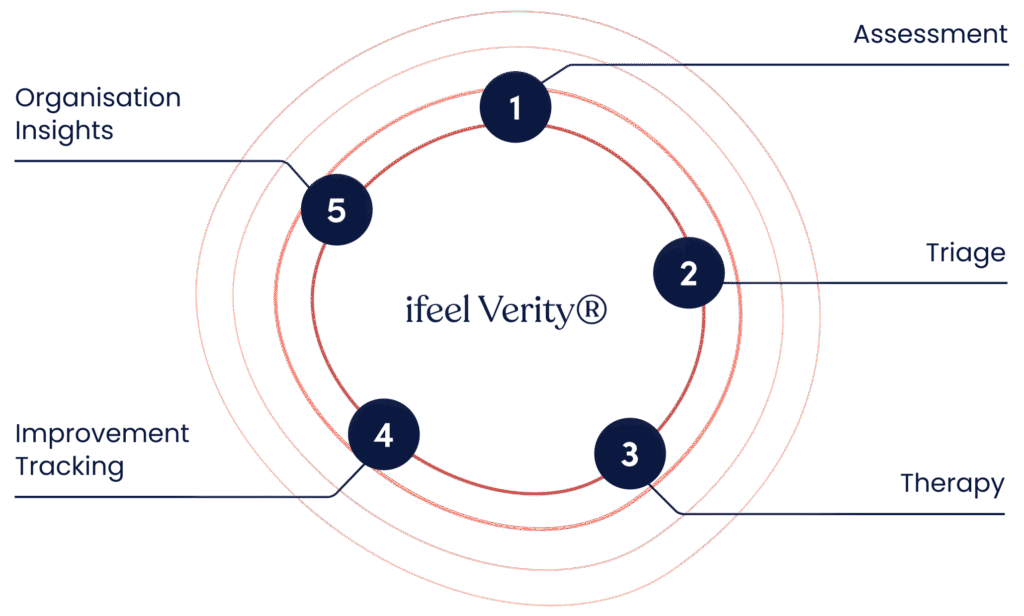
Our ifeel Verity® Model ensures every employee receives the right care at the right time. It’s a clinician-led, technology-supported process combining:

AI-powered triage to prioritise risk and match therapists to need

Therapist-led intervention for meaningful human connection

Continuous measurement across every stage

Data aggregation to inform HR and wellbeing strategies

This system translates personal recovery into measurable organisational impact, bridging individual well-being with business performance.

EN ifeel Verity® 1
CVN

The science behind care

This research was conducted by ifeel’s Research & Clinical Department, comprising licensed psychologists, behavioural scientists, and data specialists.

We apply a continuous feedback methodology: Every session, every survey, every measurement feeds into an evidence ecosystem that optimises care and validates our outcomes.

“We’re redefining digital therapy through science. Each improvement measured represents a meaningful human change.”

– ifeel’s Research & Clinical Team

Access the full research report

The landing gives you the headline. The report gives you the evidence. Inside, you’ll find the full recovery curves, the triage variables that predict risk, the methodology behind ifeel’s engagement rates, and the practical implications for building a mental health strategy that performs. Download it now — and see what the right care, at the right time, can do for your organisation.

EN cover The right care 1