Transforming outcomes for high‑risk employees
Evidence from digital mental‑health interventions
This report presents the findings of a study conducted with employees identified as high‑risk through ifeel’s clinical assessment framework. Using three validated scales : SOFAS, GAD‑7 and PHQ‑9 , we analysed how their social and occupational functioning evolved when accessing digital psychological interventions.
The data show that employees with severe functional impairment can experience significant improvements within just 3 to 6 months, reducing the risk of prolonged absence and enhancing workplace performance.
What this report includes
- How high‑risk cases are detected using functional and symptomatic criteria.
- The most common clinical and sociodemographic profiles within this population.
- The real impact of digital interventions on day‑to‑day functioning.
- Functional progression at months 1, 3 and 6.
- The importance of the dual assessment stream: self‑evaluation plus clinical review.
- Practical implications for HR, occupational health and wellbeing teams.
Key Findings
Significant and sustained functional recovery
High‑risk users show an average improvement of +18 points on the SOFAS scale, with even greater gains among those maintaining consistent therapeutic engagement. This represents a transition from severely impaired to moderately functional levels.
Rapid improvement within the first months
Functional recovery begins as early as month one, with the greatest consolidation between months three and six, when most participants surpass the clinical threshold for impairment.
Half of high‑risk cases go undetected during initial triage
A substantial proportion of high‑risk employees were identified by psychologists during ongoing therapy, not at first screening — highlighting the added value of combining automated assessments with continuous clinical monitoring.
Differences between functional and symptomatic risk
- Groups identified through SOFAS display greater functional severity and higher therapy consistency.
- Groups identified by symptom‑based scales (GAD‑7 and PHQ‑9) tend to engage in shorter interventions, often relying on text‑based therapy.
Digital interventions that are effective, efficient and scalable
The study demonstrates that these interventions:
- Are effective: they deliver measurable improvements in users’ real‑world functioning.
- Are efficient: they prioritise resources according to clinical severity.
- Are scalable: they achieve consistent outcomes across different countries, age groups and professional sectors.
Translating clinical change into business impact
Our patients report:
30%
reduction in absenteeism risk among high-risk employees
3x ROI
within 12 months of implementation
80%
satisfaction among HR leaders and employees using the platform
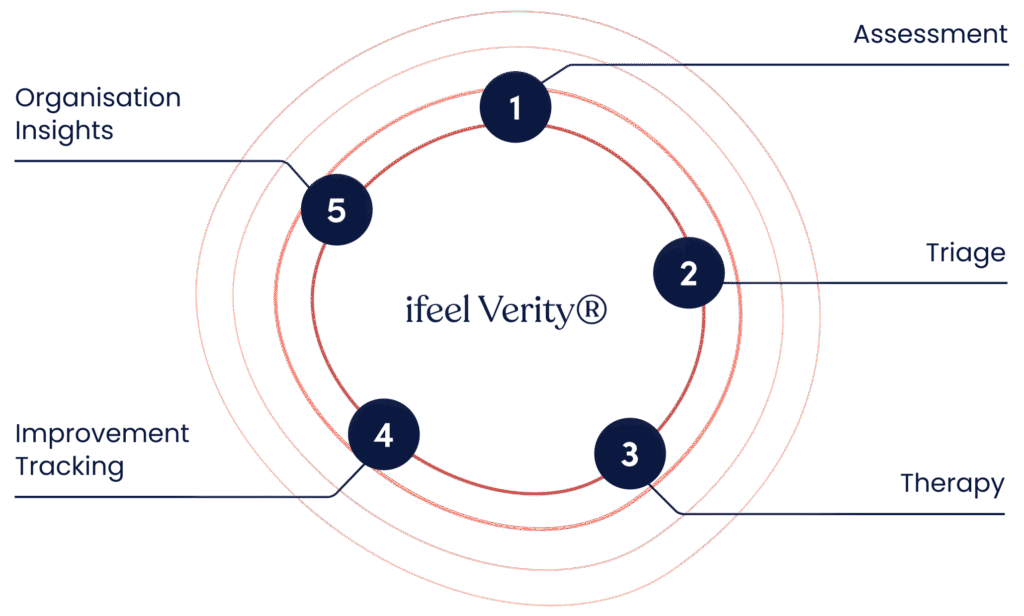
The ifeel Verity® Model
Our ifeel Verity® Model ensures every employee receives the right care at the right time. It’s a clinician-led, technology-supported process combining:
AI-powered triage to prioritise risk and match therapists to need
Therapist-led intervention for meaningful human connection
Continuous measurement across every stage
Data aggregation to inform HR and wellbeing strategies
This system translates personal recovery into measurable organisational impact, bridging individual well-being with business performance.
The science behind care
This research was conducted by ifeel’s Research & Clinical Department, comprising licensed psychologists, behavioural scientists, and data specialists.
We apply a continuous feedback methodology: Every session, every survey, every measurement feeds into an evidence ecosystem that optimises care and validates our outcomes.
“We’re redefining digital therapy through science. Each improvement measured represents a meaningful human change.”
ifeel’s Research & Clinical Team
Access the full research report
Gain access to the complete dataset, clinical methodology, and insights from ifeel’s latest research. Discover how evidence-based therapy models can transform well-being in your organisation.